Friday, July 14, 2023

They Stole My Weed

While I was recently undergoing chemotherapy and radiation my son, who lives in Joburg, sent me a parcel containing edible cannabis in the form of gummies and lollipops. Well-intentioned, he believed this would help to alleviate the unpleasant side-effects of the treatment.

My taste buds had gone haywire and I had lost my appetite for almost all food and drink, so I thought there was nothing to lose by giving cannabis a try. (I had not smoked the stuff for more than two years and there wasn’t a joint in the house, otherwise I might have gone that route already.) On a Sunday, about half way through the treatment, I decided to ingest half a gummy about an hour before lunch, in the hope that it would help me face the meal. The effect of this jelly baby was pleasant but mild. I made it through the meal and, because I missed being a little pissed after the usual several glasses of vino, which now tasted like sulphuric acid, I thought I would try half a tot of brandy in water. Not only was it like drinking camel urine, but I almost immediately felt dizzy and disorientated, and I had to stagger into the bedroom, assisted by my wife, who was alarmed at the sight of my rolling eyeballs and white lips drained of blood.

I soon recovered, but it wasn’t an experience worth repeating. When I reported this to my son, he apologised for not warning me to avoid mixing marijuana with alcohol. What I had been struck down with was a classic ‘cross-fade’.

This incident got me thinking about another unfortunate experience with the herb. More than two years ago I had been cultivating a few marijuana plants intended for recreational use when thieves entered my property and removed them without my permission. I remember writing something in response to this and, after a search, found it drafted as ‘They Stole My Weed.’ Dusted off, it can finally see the light of day.

They Stole My Weed

I came back from a walk and got busy with the evening routine. When the dog began to bark I could tell that this was something serious and not trivial like a passer-by walking down the road. I ran outside, the dog continued to bark furiously and I looked about for trespassers. Too late. Suspecting the worst, I hurried to the greenhouse and, sure enough, my beautiful dagga plants were gone. There had been three of them, all over a metre tall and heavy with buds. Now all that remained were stumps, half cut through and then snapped. A slit in the shade cloth sneered at me, contemptuous of my pride in having nurtured and raised such fine specimens.

After the initial shock on discovering how I had been robbed and my private domain violated I was consumed by feelings of anger and hatred. How dare they come onto my property uninvited and steal the plants that I had spent months growing to maturity? If only Ruby had been alerted to their vile presence a few minutes earlier. She would have cornered them; I would have pressed the panic button on the remote and then attacked them with a pick handle and bludgeoned them to a pulp. Well, maybe not. They would probably have stabbed both me and the dog to death.

When I stopped seething a day or so later it occurred to me that this was not a novel experience, and when I tried to recall all that has been stolen from me over the past seventy years I was amazed at how much there was. The first item on this list was a battery razor. It was pinched from the toiletry bag I left on my bunk in the dormitory of a Youth Hostel in Venice back in 1972. In the ensuing decades I have been robbed of three bicycles, a car radio, a Toyota bakkie, a Ford Escort, three wheels off a Tazz, a ladder, half of a sound system, several metal roof sheets, a 9kg gas bottle, an angle grinder, drums of paint, garden chairs, a wheelbarrow and two 7.5kg dumbbells. And I mustn’t forget Alfonso, the Boxer puppy who was kidnapped and later released unharmed.

Considering the number of items stolen I am tempted to make some generalizations. Larceny amongst all societies is so widespread and pervasive it can be classed as a basic human trait. From an evolutionary psychologist’s perspective the ability to steal from other humans must have given individuals and groups an advantage over those less adept at thieving and pillaging. Over hundreds of thousands of years we have become genetically programmed to seize any opportunity to steal from the vulnerable, the unsuspecting and the distracted.

The petty manifestation of this is associated with the poor and the working class, but white collar crime takes place on a far grander scale and is perpetrated by people who are motivated not by necessity but by greed.  And even more devastating in their plunder than the powerful individual and the Corporation has been the criminal actions of tribes and then whole nations. Throughout the five thousand years of recorded history people have been banding together to attack other groups in order to steal their goods and their women. In the Colonial era it was about subjugating the indigenous in order to loot their riches and exploit their resources, and at the same time capture and enslave millions of individuals for the purpose of forced labour. And now, long after the abolition of slavery, the present economic system continues to deprive millions of their right to share in the wealth generated by technological advances.
The theft of my Cannabis plants has left me even more certain in my conviction that human beings are incapable of controlling their destructive impulses and that the extinction of such a verminous species would be in the interest of all other forms of life on the planet.

To view my longer work as an author, you can find me on Smashwords here.

Saturday, July 8, 2023

Not Afraid


“This is it? You’ve got to be kidding.”

“She said we mustn’t be put off by first impressions. The accommodation is around the corner to the right. It’s a pity we arrived in the dark.”

“My fault?”

“I’m not saying it’s anybody’s fault. I’m sure it will be perfectly fine.”

In the light of the headlamps, she watched him approach the dilapidated building and disappear into the dark. 

There were patches of bare plaster where the paint had fallen off. Left of centre was a big barn door flanked by an ordinary door. Another door was set in the gable above with a small-pane window to the right of it. No sign of the wooden stairs that must have once provided access. Some rusty pipe scaffolding was stacked against the left-hand corner.

As she got out of the car the blackness that had swallowed him was lit up. Passing two garage doors she came to the far end of the building.

“The key was in the lock, like she said it would be.”

A table and plastic chairs, a couch and an easy chair. On the other side of the breakfast counter was the kitchen with usual mod cons, presumably. Against the wall to the left steep wooden stairs climbed upward.

“Where’s the loo?”

He led the way through the kitchen to the bedroom. Quite spacious with a queen size bed.

Sitting on the toilet listening to the hiss and rattle of her piss and enjoying the feeling of relief, she heard him ascending. His footsteps were dulled but audible on the wooden floor overhead.

“Terrible stairs,” he said. “Not for drunks or the elderly.” He had emptied the car while she freshened up. “There’s another ensuite bedroom up there with two single beds.”

She stood at the open door and looked out into the darkness.

“No lights. It feels like an open field and I can hear frogs in the distance.”

When they opened the door in the morning they were both surprised by the unexpectedness of the scene before them.

“I could never have imagined this in the dark.”

They were looking at a paddock with half a dozen ponies slowly moving in an aimless fashion towards them, all the while nibbling at the stalks of grass that had been missed the previous day.

“Mindless,” she said. “I can’t say I envy their existence.”

“It doesn’t look like they suffer from stress.”

After breakfast he asked her if she wanted to do some exploring. Pearly Beach was about three or four k’s down the road.

“I thought I could hear the sea in the night. We’ve only just got here. I want to chill for a bit. You go and check it out.”

She put the dishes in the sink and was about to settle down with her book when she noticed that one of the ponies was standing at the fence and seemed to be staring at her. 

It stood its ground when she approached, and even let her stroke its head and muzzle. The brown eyes were calm but expressionless. Thick muscular lips that did the work of hands. They parted to reveal top and bottom incisors.


“What big teeth you have,” she said aloud. Probably got a big dick, too. Nothing on show at the moment. She wondered what those leathery lips felt like.

There were no sugar lumps in the kitchen, so she spooned some jam into the palm of her hand and went back to the pony.

“Here you are; lick it. It’s better than sugar. Got more flavour. Just try it. No? Well, fuck you then.”

She wiped most of it off on the domed head of a fence pole and was about to go in to wash the rest off, when the bloody thing started licking and mouthing the post like it was giving it a blow job. Try again. This time she got the novel sensations she was after: the giant caterpillar lips and the rasping tongue doing acrobatics in the palm of her hand. So that’s what it feels like?

She had finished drying her hands when she saw the woman striding across the paddock.

Read the full story on Smashwords (free until end July).

Sunday, July 2, 2023

The One-handed Maniac


She agreed to cohabit with me only once we were married. Accordingly, after the performance of some Christian rituals and the completion of the necessary legal formalities, I held her to her word, she gave up her job and we set up home in the cottage I had built in Pearly Beach. This was in 1984, and in those days, we did not worry about how we were going to keep the wolf from the door. I used to say, ‘God will provide,’ which was rich, coming from an atheist.

One way in which I got God to provide was by taking on some small building jobs, but in those days there wasn’t much work to be found in the area. I thought of trying my hand at firewood, andas described in a previous blog post (Trees must Fall), this venture took place on the farm Groothagelkraal at a time when the property was owned by the alternative couple, Ian and Avanol Bell. I abandoned the venture after three weeks, having been reduced to a physical wreck. I was exhausted and becoming emaciated, my arms and legs were badly scratched in a hundred places and I had developed tendonitis in my right forearm from the constant stress of wielding a chainsaw. It also soon became clear that there was very little money to be made after deducting expenses like wages for two helpers, chain oil, petrol and chain sharpening.

When I heard about a charcoal kiln for sale, I thought this might be an easier way to turn Rooikrans trees into a commercial product that could yield an income. Charcoal is produced by partially burning wood in a space starved of oxygen. The kiln was about 2meters long, 1.2 wide and 1.5 high. It was built with heavy steel plate, had a chimney at one end and a meter-by-meter hatch on top. The thing weighed a ton and transporting it proved to be a nightmarish operation. After positioning it close to a dense stand of rooikrans, I set to work cutting enough meter-long pieces to pack the kiln two thirds full. This took three days. Then I had to find a quantity of dry wood with which to build a fire on top of the stack. Once the flames had taken hold, the hatch had been closed and  sealed with soil, and smoke was rising from the metal chimney, I went home.

When I returned in the morning it was clear that the fire had gone out. At the third attempt the starter blaze spread to the main bulk of wood and The chimney smoked for a week. On opening the hatch, I was delighted to find that the lengths of wood were black, brittle and lightweight. Genuine charcoal! I began to pack my black gold into bags, thinking I was now in business. Then, halfway down, the branches became heavier and uncharred. This meant that more than a third of the load would have to be refired.

I persevered for another six weeks and ended up with about a hundred bags of charcoal of dubious quality. It was time to admit defeat and move on. Neither firewood nor charcoal were going to provide me with a living, and I added them to my list of failed enterprises.

The kiln was abandoned and left to rust and eventually disintegrate where it stood, and I put it from my thoughts. Then, about a year later, my wife came across a news item in the Cape Times.

“Remember that man who sold you the kiln?”

Of course I remembered him. He had been making charcoal on a small holding beyond Klein Paradijs on the way to B’bos.

“I told you he was a bit creepy. And it wasn’t just that stump. It was something about his eyes. And his mouth.”

The stump she was referring to was the one at the end of his right arm. I know it was his right arm because, on first meeting him, I tried to shake hands, and was confused and then embarrassed when he extended his left hand and I was obliged to reciprocate.

She read the newspaper report to me, and it was without doubt about the same man who had sold me the kiln. Now living in Cape Town, he had been arrested for amputating some of the fingers of three women. The victims themselves had refused to lay charges, but family members had gone to the police, claiming that the women were under the man’s spell and had been persuaded that losing a finger would be a transformative psychological experience. The case was postponed while the man was ordered to undergo psychiatric assessment at Valkenberg.

“Really weird,” I said. “It’s hard to imagine how they got sucked into that mental space. Dark, man, dark.”

“And to think that this psycho was here in our house when he came for his money! Sitting in the lounge, in the rocking chair drinking coffee!”

“It’s like with these religious cults. People get drawn into crazy stuff and lose touch with reality. Reminds me of Goya: The sleep of reason produces monsters.”

We never heard what happened to the case, but over time the episode established itself as a legendary memory worthy of revisiting from time to time.

Because the idea of getting a kick out of having a finger cut off was so bizarre, I thought it would be interesting to explore it as an example of psychotic behaviour by incorporating it in a piece of fiction. The opportunity to do this finally arrived about two years ago.

My son and his partner were staying in some accommodation on a small holding not far from where the one-handed maniac had lived. When I saw the building I immediately thought that this was the perfect setting for a creepy story. I asked him to photograph it at night, and the result was even more charged with gothic undertones than I had hoped for. This, I thought, would make the perfect cover illustration for the story that was still to be written.


To view my longer work as an author, you can find me on Smashwords here.

Wednesday, June 21, 2023

On the Beach: Sea Foam


 To make up for disrupting power supply for three days, the recent winter storm generated a massive amount of sea foam and drove it ashore on Monday. It was a spectacular natural event resulting in what was variously described as soap suds, whipped cream, cotton wool and souffle, depending on one’s imagination, and varied in colour from dirty brown to shades of yellow to pure white. On Tuesday it was all gone.

There is an informative article on Wikipedia, which describes and explains the phenomenon, and is well worth reading. Here is an extract:

Sea foam, ocean foam, beach foam, or spume is a type of foam created by the agitation of seawater, particularly when it contains higher concentrations of dissolved organic matter (including proteins, lignins, and lipids) derived from sources such as the offshore breakdown of algal blooms.[1] These compounds can act as surfactants or foaming agents. As the seawater is churned by breaking waves in the surf zone adjacent to the shore, the surfactants under these turbulent conditions trap air, forming persistent bubbles that stick to each other through surface tension.

Sea foam is a global phenomenon,[1] and it varies depending on location and the potential influence of the surrounding marine, freshwater, and/or terrestrial environments.[2] Due to its low density and persistence, foam can be blown by strong on-shore winds from the beach face inland.


To view my longer work as an author, you can find me on Smashwords here.

Tuesday, June 20, 2023

Memory Project: The Crystal Set


A crystal radio receiver, also called a crystal set, is a simple radio receiver popular in the early days of radio. It uses only the power of the received radio signal to produce sound, needing no external power. It is named for its most important component, a crystal detector, originally made from a piece of crystalline mineral such as Galena. This component is now called a diode.

Crystal radios are the simplest type of radio receiver and can be made with a few inexpensive parts, such as a wire for an antenna, a coil of wire, a capacitor, a crystal detector, and earphones. Crystal radios are passive receivers, while other radios use an amplifier powered by current from a battery or wall outlet to make the radio signal louder. Thus, crystal sets produce rather weak sound and must be listened to with sensitive earphones, and can only receive stations within a limited range. - Wikipedia

My parents’ radio was positioned on the record cabinet in the lounge. This cabinet had been custom made in Fish Hoek by Percy Webb and was designed to take the record turntable on a pull-out shelf. The collection of vinyl records stood in the compartments below. I think they could get the BBC on shortwave but they listened mostly to the SABC English Program on medium wave.

Alan also had a radio. His bed was in the corner of his room, had an iron frame and stood high off the ground. It was similar to the houseboy’s bed, only it had a better mattress. Next to the bed and facing the window was a blue painted table that served as his homework desk. The large, old-fashioned radio that had been bought second hand sat on the side of the table facing the bed.

He liked to lie in bed at night and listen to English football commentary and comedy programs like ‘Round the Horne,’ ‘The Glums,’ ‘Hancock’s Half Hour’ and his favorite, ‘The Goon Show.’ We were treated to sweets on a Friday night and he would chew toffees while listening and then throw the wrappers under the table. When my parents objected to this slovenly habit he preferred to stand on a chair and push the sweet papers through a triangular tear in the metal ceiling rather than put them in the dustbin. Another of his practices was to pick his nose and stick the ‘bogeys’ to the underside of the table, where they dried out and became quite a collection. I know this because I used to join him in bed for some of the comedy programs and witnessed the procedure on numerous occasions.

Like many young children I sucked my thumb. This was mildly discouraged, but when I was nearly seven and still doing it my parents became concerned and decided to try and cure me of it with some bribery. If I were to quit the habit they would buy me a crystal set.

The one they bought for me consisted of a small cream and red plastic case that could be pulled apart to reveal the rudimentary components, a pair of second hand earphones and a long piece of insulated copper wire. This wire was the aerial and was strung from my bedroom window to the tall syringa in the corner of the plot. There was a tuning dial but no volume control, there being no power source to amplify the signal.

I continued to suck my thumb for another year or so, but less and less frequently and only in secret. It seems that I was a rather pathetic little shit at that time.

To view my longer work as an author, you can find me on Smashwords here.

Thursday, June 15, 2023

The Man in the Plastic Mask


Doctor D phoned to say that the PET scan showed my lungs to be clear except for a non-malignant nodule, which meant curative treatment of the cancer in my neck could proceed. This would entail six weeks of chemo and radiotherapy.

By using the word ‘curative’ I understood him to mean he expected to delay my demise by as much as a decade. If he thought I only had a year or two left, he would have said ‘palliative.’

The next day, Friday the 28th of October, 2022, Karien from Oncology phoned to say that I should be at the Centre at 2.30 to be fitted with a mask before undergoing a scan. We scurried about, jumped in the car, and K got me there with ten minutes to spare.

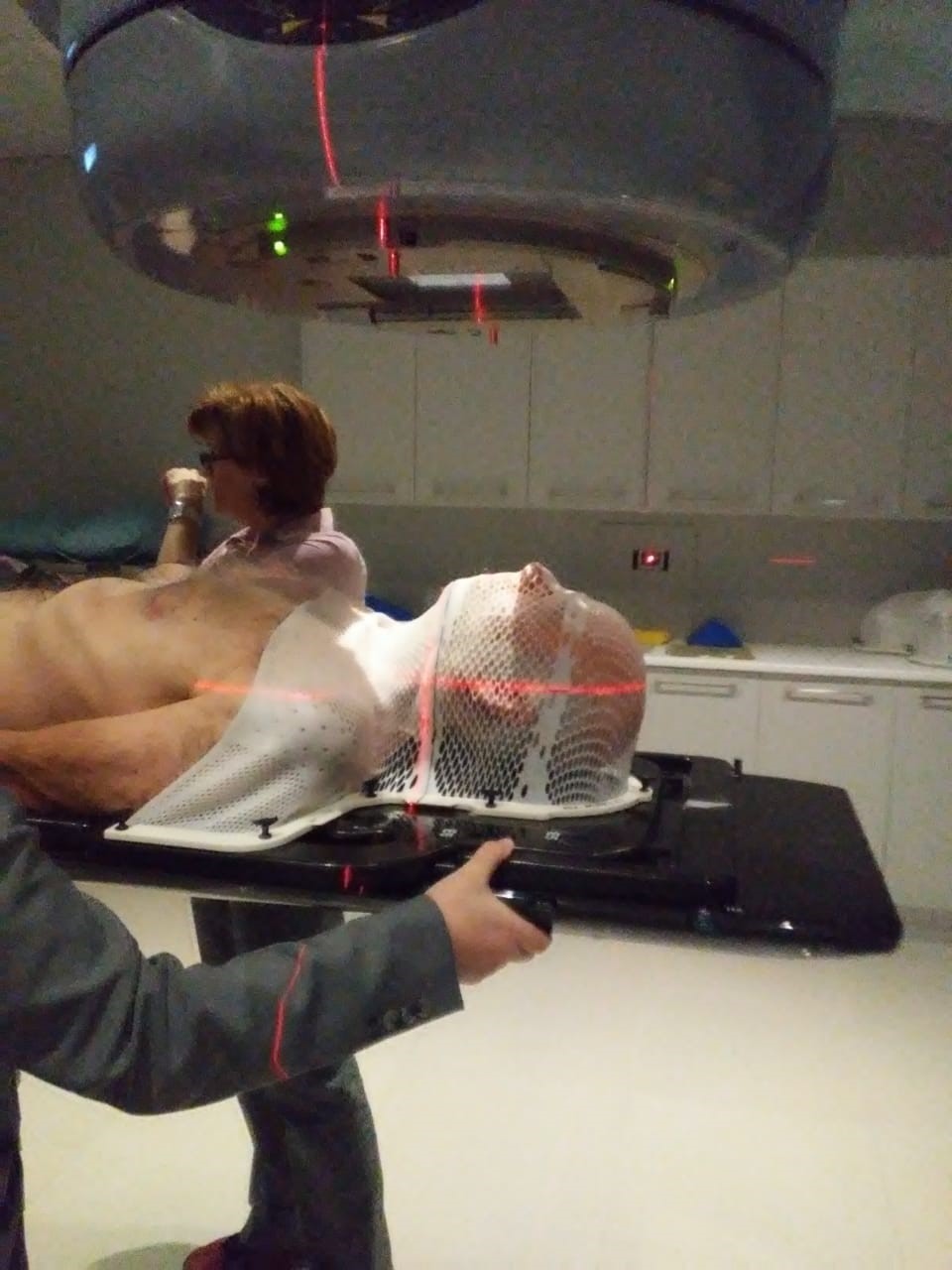
In the Radiology waiting room there was a comfortable black leather couch, which the receptionist urged us to make use of, but we had barely seated ourselves when Karien and Rochelle arrived and welcomed us in a friendly fashion. We followed them down a sloping passage into the radiation bunker. They explained that I would be fitted with a mask that would be used to position my head in precisely the same place for each treatment. I lay on the table that stood before the radiation equipment, the mask was heated in some kind of microwave oven to soften it and, while it was still warm and waxy they pressed it down on my nose, forehead and chin, moulding it to my features with their fingers.


The radiation therapists explained that they now needed a scan of my head and shoulders for them to direct the radioactive rays to target the cancerous areas with the utmost precision. Accordingly, we drove the short distance to Mediclinic, I again put my head into the white doughnut, and then it was back to Oncology.

I again removed my shirt and lay on the hard plastic bench, a wedge under my knees and one behind my neck. The mask was fitted over my face and they fastened it down at its nine anchor points. To say it was a snug fit would be an understatement. My head was completely immobilised and I could barely move my eyelids. They asked me if I was all right and whether I felt claustrophobic, to which I grunted in the affirmative and the negative. Flor the next ten minutes or so they took measurements, drew lines on the mask and calibrated their instruments in the control room. The mask was unfastened and removed, and I was free to go home, have a dop and braai some Friday fish. The preparatory work being complete, treatment could commence on Monday.

To view my longer work as an author, you can find me on Smashwords here.

Monday, June 12, 2023

Fake News and A Short Story


FAKE NEWS. The snail (Achatina fulica) originates in East Africa and only began to appear in the Western Cape about 15 years ago. This snail species has become a significant pest around the world. Internationally, it is the most frequently occurring invasive species of snail.

Outside of its native range, this snail thrives in many types of habitat in areas with mild climates. It feeds voraciously and is a vector for plant pathogens, causing severe damage to agricultural crops and native plants. It competes with native snail taxa, is a nuisance pest of urban areas, and spreads human disease. This snail is listed as one of the top 100 invasive species in the world.

An increase in physical size of the snail was first observed in the Southern Cape in 2017 and the mutation of growth genes was confirmed by zoologists from the University of Stellenbosch at the end of 2018. The team of scientists led by Dr Hans Gastrow established that the snail was increasing in body mass by 5 percent every three generations. In November 2019 it was announced that the gastropod’s feeding habits had changed from herbivorous to omnivorous. Dr Gastrow has warned that the mutant form of Achatina fulica poses a serious threat to plant and animal life in the coastal zone between Gansbaai and Die Dam, and its eradication should be seen as a matter of extreme urgency.


THE STORY. When Mike reached 65 and sold his share in the firm, he and Cheryl put their Cape Town house on the market. Their holiday cottage in Pearly Beach had been recently renovated and they relocated at the end of 2016.

That first Christmas in Pearly was wonderful. Their three children and their partners rented a house on the seafront and the festivities lasted for two weeks. Then Mike and Cheryl settled into comfortable retirement. They upgraded their PC, the computer people installed an antenna and connected them to the Internet, and a new satellite dish gave them DSTV reception better than it had been in town. They might be in the countryside but there was no sense of being cut off from the outside world.

Cheryl joined a Bible group and Mike found some buddies to go fishing with, or meet in one of the drinking holes to swop yarns and discuss the state of affairs in the country. They became members of the Angling and Recreation Club, and sometimes went for a meal on Club night and socialized with other residents. As they expanded their circle of acquaintances they discovered the reality of small town politics, which meant being drawn into one of the antagonistic factions.

“I suppose it makes life interesting,” Mike told his wife. “But we must be careful not to get too involved.”

Phil, their youngest, lived in Joburg but both Jane and Keith were in Cape Town, and every few weeks one of them would pay a visit, or Mike and Cheryl would spend a couple of days in the city. Of course there was also the phone and the WhatsApp group to keep them feeling connected

When Phil announced that he and his wife had been offered positions at separate law firms in Sydney, and that they would be leaving as soon as the emigration papers had been processed, it came as a disappointment rather than a shock.

“Don’t worry, Mum,” he told Cheryl. “We’ll come back on holiday and you and Dad can come and visit us once we’re settled.”

The shock came not six months later. Keith was unable to hide his feelings of guilt when he told them that he and Meg wanted to start a family but felt there was no future for white kids in South Africa. They were considering job offers in London. It made sense to choose the UK, because Meg’s brothers were there and her parents had made the move a year ago.

“You can’t blame them,” Mike said. “South Africa is a mess. Trump is right: this is a shithole country”

This did nothing to console Cheryl, who was in tears.  “It feels like they are abandoning us. Both of our sons will be gone. At least Jane is here. It’s like my mother used to say: A son is a son until he gets him a wife. But a daughter is a daughter all of her life.”

All of her life until she gets hijacked. She wasn’t beaten up or raped, but being driven around in the company of three villains for an hour, and then being left at the side of the road on the N2 left its mark.

“I just can’t get it out of my head, and I know I will never feel safe again.”

She and her husband had any number of friends who had settled in London, and John and his wife were there. It made sense to try for a new beginning in England, and they packed their bags and left in February 2019.

“If we hadn’t invested so heavily in their education we could join them. But even if the Brits let us in, which is unlikely at our age, we would have to live like poor whites. Our money wouldn’t go far in the UK. To think how much we spent on private schools and putting them through university! And now all three of them have buggered off.”

From then on Mike referred to emigration as buggering off.

They continued to walk on the beach at low tide when the weather was good, and they pottered about in the garden, but it took more of an effort to remain active. Boredom and apathy replaced zest and enthusiasm, and they began to slow down, both physically and mentally. Mike’s hypertension meds had to be adjusted and the doctor put Cheryl on antidepressants and gave her something for anxiety.

When they could no longer ignore the sight of their spouse’s expanding waistline they resolved to cut back on their drinking. No more sundowners and snacks from Monday to Thursday. Although it was tough at first the discipline did them some good and they even lost a couple of kilograms. But there was the danger of making up for abstinence in the week by overdoing it on the weekend. It was hard not to binge on Friday and Saturday nights, and if they weren’t careful they could go through two bottles of wine with Sunday lunch.

Their discontent was further fuelled by what was going on in the country as well as globally. The economy was shrinking, unemployment was growing, and crime was on the increase. More and more corruption was being exposed but the justice system was paralysed. The State Owned Enterprises had been looted and were collapsing, and most infuriating of all was Eskom and the constant power cuts.

“The bloody ANC has destroyed the country,” Mike complained to his wife. He was becoming increasingly racist with his pronouncements. “Wherever these blacks take control there’s a guaranteed disaster. And these idiots are still talking about Expropriation Without Compensation! It’s not going to be long before we become a basket case like Zimbabwe.”

“What I worry about is the NHI,” said Cheryl. “I’m sure they want to destroy private health care, and then our medical aid will be worthless.”

“I know. Imagine what will happen if the virus gets going in Africa. God, it’s such a tragedy we can’t afford to bugger off like the kids have done!”

He got up to open another window. That wind blowing from the East felt like it was coming from a furnace, but at least it helped to evaporate sweat. He looked out at the lawn, which should have been parched yellow at this time of the year. Instead. It was green and lush, evidence of galloping climate change. As predicted, sub-Saharan countries were going to be hit hard. Floods and droughts and tornados would become commonplace. It was another reason to bugger off if you could afford to.

He was about to turn away when he caught sight of one of those giant snails that were plaguing the area. God it was huge! It was at least as big as a soccer ball, if not bigger. Leaving a trail of slime behind it the creature was advancing across the lawn towards the flower bed. It was probably intent on polishing off what was left of the petunias and calendulas. He certainly wasn’t going outside to deal with it. Trying to kill the thing and dispose of it was just too much of a mission, what with all that disgusting slime it exuded.

It was a week later and the last Sunday in February. There had been three days of black southeaster and the incessant drizzle had deposited 60mm in the rain gauge. In the late morning the wind dropped and it looked like the weather might clear. The summer sun burned holes in the thin cloud cover and it became horribly hot and humid.

“No ways I’m doing a braai,” Mike declared. “Not in this heat.”

“Any excuse will do,” said Cheryl. “But don’t expect me to stand slaving over a hot stove.” She put the chops and sausage back in the freezer and took out two Woolies meals to start defrosting.

“Pathetic bunch of losers!” Mike snarled as he turned off the TV. “Ninety-eight all out! I can’t bear to watch. The series is going to be a whitewash.”

“Shall we watch another episode of Downton Abbey before lunch?”

“Alright. Like a glass of wine?”

They had developed a strategy whereby they could justify opening two bottles. It entailed starting with the first one well before the meal. It felt perfectly acceptable for him to be opening the second bottle just as she served the food. To crack number two any later would have made them feel like old boozers.

They shared a lasagne and a quiche, and ended with ice cream and chocolate sauce, which was nice and easy. Then they finished the wine and sat back.

“God, but it’s hot! I’m sweating like a pig.” And this was in spite of removing his shirt and footwear.

“And Jane says it’s six degrees in London! I’m going to go and lie down before I die.”

“I’ll try lying on the floor,” Mike said. “It might be cooler than on the bed.” He pulled the cushions off the couch and spread them on the tiled surface facing the open sliding door. Before long they were both on their backs snoring, their mouths wide open.

Outside there was no movement of air and low cloud cover was trapping the heat. On the lawn a giant African land snail had paused in its progress and was trying to decide where to go next. Its brown striped shell was twice the size of a football and lay on top of the stretched out metre long body. Its head was raised high and moved from side to side. The two pairs of feelers waved in different directions like surveillance antennae gathering data. Then its slime engine started up, revved, and the monster travelled forward on its route to the house.

It mounted the step to the stoep with ease and began its convulsive progress into the living room. Level with Mike’s bare feet it came to a halt in order to reconnoitre. Again it started up and advanced. With its head and half of its oozing underbelly raised high it stood poised above the sleeping man.

Cheryl awoke with a jerk. It was gone five but still stifling hot and she felt terrible. Her mouth was dry, her head ached, and when she called out to Mike her voice sounded like that of an old witch. She called again but there was no reply. No snoring, so he must be up. Unsteady on her feet, she lurched into the living room and then acted like she had walked into a wall. Mike was still on the floor but he wasn’t alone. The snail was spread out on him and its loathsome flesh enveloped his upper body while its head was at his face.

She screamed and shouted for help and pushed and pulled to no avail. Her neighbour arrived and after screaming and covering her eyes said she would call Lofty. He was the local paramedic and was also an electrician and a handyman, and he would know what to do.

When Lofty arrived he looked a little groggy but was perfectly steady on his feet. After assessing the situation he said the only way to deal with this snail was to electrocute it. Stage four load shedding had just kicked in so he went to his bakkie, disconnected the battery and came back with it, along with some tools. Using jumper leads and a length of copper wire he was able to pass an electrical current through the hideous creature. It immediately lifted its head and began to writhe and convulse. Only after five minutes when it finally lay motionless did Lofty disconnect the power and they were able to separate the snail from Mike’s lifeless body.

When they cleaned the viscous sludge from his face they were horrified to discover that his eye sockets were empty, his lips had been stripped away and a start had been made on his tongue.

“Don’t worry, it would have been quick,” Lofty said. “He would have choked on the slime almost immediately, you see. Death by asphyxiation.”

Naturally, Cheryl was in a terrible state. Jane and Keith’s wife immediately flew out to be with her, and the entire family made it to the funeral.

“You will have to come and live with us in London, Mummy,” Jane insisted. “You can’t stay on your own in this dreadful country.”

Cheryl had to agree. With the insurance money and what she could get for the house it was now possible to make the move. With a feeling of bitterness she acknowledged that it had taken this catastrophe to enable at least one of them to bugger off.

To view my longer work as an author, you can find me on Smashwords here.

Where AI Fears to Tread

    (Photo: KT Martin)   My wife was away. It was she who suggested I take a drive out to Agulhas. Three years have gone by since ...