Saturday, December 21, 2024

The Ashton Bridge

Photo: Nina Martin


When I heard on the radio they were going to build a new bridge over the Cogmans River at Ashton, and that it would be the first tied arch design to be constructed in South Africa, I looked at my wife and said, “That sounds interesting.”

“What is a tied arch bridge?”

“Never heard of it before. My knowledge of bridge designs does not extend beyond suspension, truss, cantilever, and ordinary arch bridges.”

“You are forgetting our bridge at Uilkraal, the beam bridge, the oldest and simplest design of all.”

“Oh, yes. Like a tree trunk over a stream. And rope bridges are another example of early technology.”

“Yes, but a rope bridge is a form of suspension bridge.”

“Hmm.” I could see she knew just as much, if not more, about bridge design as I did. “Well, we will have to do some research if we want to know what’s so great about a tied arch bridge.”

This is what we came up with:

A tied arch bridge is a structural form that combines elements of both arch and suspension bridges. It features an arch rib on either side of the roadway, connected by a horizontal tie beam at the bottom, which supports the bridge deck. This design allows for efficient load distribution and offers several advantages in terms of construction and aesthetics.

“They are going to use a transverse launching method, which sounds quite mind-blowing,” I told her. “It means building the new bridge alongside the old one, which will be demolished to make way for the 800-ton structure that will be dragged sideways into place. Amazing, hey?”

This was back in 2019, two years before the project was due for completion. We agreed to follow progress and attend the opening. Well, that was the intention, but circumstances changed and we did not make it. However, it remained on the bucket list and we finally found time to undertake the expedition in October of this year, 2024.

Guy was down from Joburg on a two-week visit, having had to leave his wife behind on account of work commitments, which was a pity, but at least it freed him up to do a considerable amount of maintenance work on the parental abode. We chose a Wednesday so that Nina and Anthony could join us on the family outing, and the five of us set off in our trusty 1998 Toyota Venture just after 9.30.

I had promoted the trip as a wonderful opportunity to enjoy a drive through scenic and varied countryside in order to view a unique example of how modern technology and aesthetics can combine to produce a work of functional beauty. The first part of this spiel lived up to the hyperbole, as it was a fine Spring day with a clear sky and mild temperatures, and the changing scenery was a delight to behold.

“You know,” I said at one stage of the journey, “I have been looking at some of Anna’s photography books, and it strikes me that colour is a distraction, and black and white is better able to capture the essence of a scene. Take that ruined farm building we just passed. Photographers like David Goldblatt and Walker Evans would have been able to get us to think about the history of the building, and what had led to it being abandoned and falling into decay.”


“Why can’t that be done with colour?” Nina, who was driving, said. “I don’t agree. Colour can be just as powerful. It’s composition that makes an exceptional picture, whether in colour or black and white.”

Also keen photographers, the other two millennials concurred with her.

“That old house made me think of Walter Meyer,” Krystyna, who was in the front passenger seat, said. “It’s just the sort of building he painted, and he would have made it look as stark and forlorn as a Goldblatt photo, only in colour.”

It seemed like they all thought I was on the wrong track. A little miffed, I thought of saying something provocative about the monotonously pretty countryside we were travelling through, and pointing out how predictably picturesque it was, but we were entering the lovely little town of Bonnievale, and I got distracted.

We trundled through the streets, admiring the unpretentious nineteenth and early twentieth century architecture and enjoying the peaceful atmosphere of a country dorp, and then made our way over the mountain to our destination. Anthony and I were in the second row, while poor old guy was sitting sideways in the dogbox.

As we entered Ashton, we caught our first sight of the bridge, and it certainly wasn’t a disappointment. The simple elegance of the gleaming white arches immediately convinced me that we were looking at a work of art. We passed over the bridge, Nina parked in front of some shops, and we all got out, eager to take a closer look.


was an information board that gave the background story to what had necessitated the whole enterprise, and furnished some interesting facts about the construction process. Kryś read it to me and then we walked the 60 metres along the pedestrian pathway to the centre of the bridge. I know it was 60 because the info board had said the span was 120 metres. We looked down at the gently flowing stream as it made its way through reeds and fern-covered banks.


“It’s hard to believe this could become a huge river, flooding the whole valley. But those pictures of the old bridge being submerged is proof of what is possible. It would be an awesome experience to stand here and watch that massive body of water flowing at speed just a few metres beneath our feet.”

“As TS Eliot pointed out,” I said,” the river is a strong brown god, implacable.
Keeping his seasons and rages, destroyer, reminder
of what men choose to forget.”

“Look, there’s Guy and Nina and Anthony checking out the underside of the bridge. Let’s walk to the end, and then come back and join them.”

It was at the far end of the arch that I received a kick in the groin. On the pristine white concrete somebody had sprayed graffiti. Crude black letters spelling a name or an obscenity, and some random shapes and scrawls. Appalled, all I could say was, “Fuck, no!”

“Hopefully, they can clean it off.”

We walked back and followed a rough path down towards the river. The young people were under

the bridge taking pictures and, as we made our way towards them over the rough ground, I again felt

a surge of dismay. Scattered about beneath the ribbed deck was the usual rubbish associated with

all open places in South Africa (and most of the world) that offer shelter from the sun and the rain.

Plastic bags and containers, broken bottles, cooldrink cans, some filthy rags.

Guy joined us. “It looks like people could be living over there on the other side.” He was pointing his Nikon and zooming in. He showed me the image that had captured five young men sitting in a group. “I wonder what they’re smoking?”


We made our way back to the parking area, where Anthony was standing before a monumental

locomotive reading the plaque. This relic from the days of steam is a historical reminder that

The town of Ashton is named after Job Ashton, the railway engineer and director of the New Cape Central Railways (Ltd). The town was established in 1897 on the Roodewal farm, and was originally a trading post that became a railway station after the completion of the railway line from Worcester to the coast in 1887.
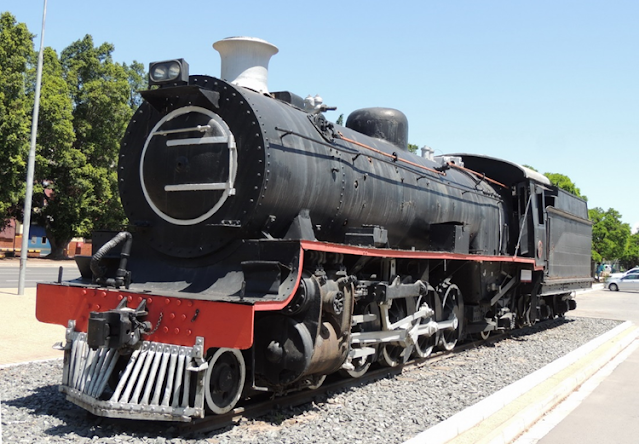

We gathered around the iron monster, marvelling at its size and trying to imagine, and in the case of us two oldies, actually remember what it was like to take a train drawn by just such a puffing billy. True to form, Guy climbed as high as he could and stood atop the huge black boiler, and I hoisted myself up into the open cab. So this was where the driver and stoker worked. This must have been one hell of a tough life, I thought.


“Jesus, what’s that smell?” I asked. Guy had just climbed aboard.

“Shit.” He pointed to the coal chute behind us. “People have been using this as a toilet. Maybe out of necessity, or possibly as a political statement.”

“Fucking human beings!” I snarled as I returned to terra firma as fast as my arthritic joints permitted, the stench having taken up residence in my nostrils.


“People are disgusting,” my wife agreed, as she sprayed sanitizer on my hand. “I hope you haven’t got anything on your shoes.”


It was time for lunch. We piled into the Venture and continued on Route 62 through the Cogmanskloof Pass to Montagu, which turned out to be nothing like my memory of it from forty years ago. The streets were tree-lined and there was evidence of gentrification everywhere. Very pleasant, very bucolic, and oh so generic. Just like Macgregor, and Greyton, and Napier, and Stanford. The well-heeled retirees and the larnies who could afford a country retreat had booted out the real people who used to live there, and colonised the place.


We chose a shady spot to stop and eat our sandwiches. There was a low-level bridge over a gurgling stream just a little way down the road and it seemed we had the place to ourselves. How wrong we were!

“Did you see how that hoity-toity bitch glared at us?” Nina, who was munching on her homemade cheese, ham and tomato sandwich, was referring to the fortyish woman in a Pajero who had been obliged to pull up behind us in order to allow an oncoming vehicle to pass.

“I bet she would love the cops to have us poor whites run out of town,” said Anthony.

It became apparent that most of the traffic consisted of SUV’s driven by women accompanied by children, which meant we were parked on a regular school route.

“Now for the beer tasting,” Guy said, having finished his nartjie. “Google says Route 62 Brewery is just two blocks away.”

It looked more like a restaurant than a brewery. There was one man at the bar talking to two of the staff, but otherwise we were the only patrons. The waitress, who had an open face and shapely figure, brought three trays of the six tasters. After sipping all six brews we were unanimous in judging the stout to be excellent. Opinion was divided about the others, but none were condemned outright.

When all of the eighteen little glasses had been drained, I would have been happy to depart. Not so fast, old man. The three of them ordered a pint of their chosen draught, insisting that this is what you do at a beer tasting. Oh, well, I thought, when I was their age I, too, would not have been averse to be feeling mildly inebriated on leaving a licensed premises.


I enjoyed the ride back. The afternoon was advancing and the countryside looked different, now that the sun was coming at it from the west. The glare had gone and shadows were developing and softening the texture of the landscape. I was reminded of the time before we were married, when Kryś and I took a trip to South West Africa. I had particularly liked the mellow feeling that came over me while heading north, the sun going down on our left, she at the wheel, while I relaxed with a glass of Bols brandy and water. Yes, very mellow and carefree. Just as I was thinking this, Guy spoke from the dogbox.

“Anyone like to try some Muscadel?”

He had bought local liquor from one of the shops where we had parked in Ashton. A brandy and two bottles of muscadel, red and white, produced by Montagu Winery.

“Hell, now you’re talking, my boy!” He pored me half a coffee mug of the red stuff.”Shit, I only wanted a taste,” I lied. “But thanks, anyway. Cheers!”

Anthony had just opened a craft beer, and mother and daughter up front declined the offer of sweet fortified vino. I sipped the dark nectar and savoured its calming effect.

“This is a fine muscadel, ideally suitable for the occasion. Here we are, following the road over these rolling hills towards the setting sun, feeling comfortably relaxed in good company. This is just the perfect beverage to lubricate one’s mental machinery.”

“And loosen the tongue,” I heard Krystyna say to Nina.

“It has been a really interesting day. Enriching, if you know what I mean. Breaking fresh ground on our pilgrimage to the famous bridge, and then standing in awe before that monument to technological ingenuity combined with aesthetic beauty. It was so uplifting, it made one proud to be a member of the same species that was capable of such an achievement.”

“Where is he going with this rubbish?” Nina asked.

“Be patient. He’ll get there eventually.”

“Yes, as I was saying, imagine my disappointment, the abrupt deflation of my elation, so to speak, when I clapped eyes on that crude graffiti, that barbaric act of desecration! And when descending to examine the ribbed underbelly of the structure, what did we discover?”

“Trash,” said Anthony, and he took another swig. “The usual trash left by the homeless. It was to be expected.”

“I suppose so, but I was dismayed, nevertheless.”

“And the locomotive?”

“I’m getting to the locomotive, Guy. Don’t rush me. Alright, just a dash.””

Mrs Martin glanced over her shoulder, her eyebrows raised in disapproval, but she refrained from urging restraint.

“That locomotive was put there for a reason. It was to memorialise the town’s origins and to educate the public about the time when steam engines were at the forefront of technology. It was a relic from the early 20th century to be admired and wondered at. When I climbed up into that cab, I was marvelling at the simplicity of the design. A coal-fired boiler on wheels, water heated to produce steam under pressure, and the energy released to drive pistons that turn wheels. What  a brilliant concept!”

“And what did you find up there that left you shattered?”

“For fuck’s sake!”

“Sorry. Go ahead; I won’t interrupt again.”

“Thank you. Well, there I was imagining what it must have been like to be a train driver, when something assailed my olfactory organ, and it wasn’t coal smoke. On turning around I was confronted by the sight of human excrement. Somebody had climbed onto the metal plate of the coal shute and defecated. The unmistakable stench horrified and nauseated me, and I couldn’t get off that locomotive fast enough.”

“Why are you telling us again, Daddy? We heard about it back in Ashton.” Nina was looking at me in her rear-view mirror.

“I am assimilating the events of the day, ordering and assembling them so that they fit together to reveal some underlying meaning.”

“The unexamined life is not worth living, you know, babe.” There was mockery in Anthony’s voice.

“Today’s experience can be interpreted on two levels. The amazing technology behind both the locomotive and the bridge show just how clever we humans have become. And the aesthetics of the bridge, and the noble educational intention behind displaying the locomotive, are testimony to the artistic and intellectual heights we have reached. On this level we are justified in feeling smug and patting ourselves on the back.”

“And on the other level? I suppose…”

“I thought you weren’t going to interrupt me? “

“By interjecting now and then I am helping to turn what could be a boring monologue into an engaging dialogue of the Socratic kind.”

“Very well. You might have a point.”

I paused to take note of our surroundings. We had just passed Raka Wines and were ascending Akadis Pass. I drained the last of my muscadel, which was just slightly tainted by the taste of coffee, and then picked up my train of thought.

“On the second level we must consider the significance of the graffiti, the rubbish and the excrement. The graffiti is an act of vandalism expressing resentment, defiance and contempt, just as the barbarian marauders defaced Roman art works, and smashed and toppled statues. The rubbish is evidence of a dysfunctional society where millions are unemployed and live in squalid conditions. The excrement is the result of an atavistic urge to foul the lair of one’s enemy. In combination, these three things, the graffiti, the rubbish and the excrement, clearly point to what I see as an inevitable conclusion.”

“Ah, the punchline.”

“The human brain is at a stage of development where the growth of scientific knowledge and technological innovation is almost unlimited. We have also mastered an astonishingly powerful facility for artistic expression. However, our ability to modify and control the fundamental instincts that determine our social behaviour has not kept pace with those other aspects of the evolutionary process. That is why we are still shitting on ourselves, and it would take many thousands of years for our quarrelsome and violent traits to be modified sufficiently for us to live in harmony with one another and the environment. I’m afraid that well before that could happen, we will have annihilated ourselves, along with many other forms of life.”

We had bypassed Stanford and Grootbos was on our left. The sun was low over Walker Bay, the sea glittered, and the sky was beginning to present a photo opportunity for passing tourists.

“Basically, what you are describing is a design fault,” Guy said. “Instead of developing in tandem, cognitive ability and behavioural adaptation have progressed at a different pace, resulting in the gross malfunction of both individuals and society as a whole. Definitely a design fault.”

“And what about our other design faults?” asked Anthony. Evolution has made a mess of us. Standing up and walking on our back legs might have had advantages, but it resulted in wear and tear on our joints, and the narrowing of the pelvis has made childbirth difficult and painful, not to say dangerous.”

“What about the appendix? Totally superfluous and nothing but trouble. And wisdom teeth. The mouth got smaller but the number of teeth stayed the same. Man, I’ve had to have all of mine out. That’s a design fuck-up, if ever there was one!”

“If we were an aircraft or a car, we would have been taken out of service long ago.”

“God made a major foul-up right in the beginning,” Krystyna said. “We are a failed project, and the sooner a meteorite obliterates the entire race, the better.” She sounded quite matter-of-fact about it, and even cheerful.

“Yes,” Nina agreed. “Wouldn’t it be wonderful for the rest of life on earth if humans went extinct? The only worry would be that one of our primate relatives might evolve into Homo sapiens 2.O.”

We had passed through Gansbaai, crossed the beam bridge at Uilkraal, and were almost back in Pearly Beach.

“Well,” I said, “it’s been a most interesting outing. The weather was good, the company charming, and….”

“Blah, blah, blah.”

“And thank you for doing all the driving, Nina. Much appreciated. Now we must plan for another trip, before the Apocalypse comes.”

“Too late,” said Anthony. “The end times have already begun.”


(The events are factual but the dialogue is fictional, and I apologise for putting words into people's mouths.)


To view my longer work as an author, you can find me on Smashwords here.


Wednesday, October 30, 2024

In the Podiatrist's Dental Chair


Image: Ideogram.ai


For more than a decade I paid Doctor Carey to work on my teeth whenever one or more of them caused me pain in the form of toothache. He was a soft spoken, reserved man of slight build who was moderately competent without showing enthusiasm or flair. He was also of sober habits, for which I was thankful, two of my previous dentists having been drunkards. The one was an ex-Royal Navy immigrant who refused to mess about with the drill after lunch, which he washed down with whisky, and preferred to do a quick extraction, whether it was necessary or not. I lost a perfectly salvageable molar one afternoon back in the sixties when I was a schoolboy too timid to offer any resistance. The other dronkie suffered from anxiety. To steady his shaking hands, he medicated himself with tots of neat gin prn. I stopped going to him shortly before the Health Professions Council of South Africa declared him a danger to the public and withdrew his licence.

When I moved back to Pearly Beach I had to find a dentist in Gansbaai to replace Doctor Carey. Dr Koos van der Merwe has the strong meaty hands of a platteland farmer and does what he can with my dwindling stock of toothy pegs. I get the impression he thinks I won’t be needing teeth for all that much longer.

Now for the podiatrist. Up until about the age of 60 my preferred footwear was the open sandal, which kept the feet well ventilated. Unfortunately, the dusty gravel roads began to take their toll, and I developed cracked heels and calloused toes, and the nails became thick and twisted and as hard as those of a dog. I consulted an old-school dermatologist who frequented the dorp on occasion, and he said the only effective remedy for cracked heels was a mixture of 50/50 milking cream and shaving cream. The milking cream, which could be obtained from the farmers’ co-op in Stanford, contained lanolin, and was originally used by milking maids when tugging at a cow’s udder, and was good for both hands and teats. I tried it for several weeks and found it almost entirely useless. That was when I decided to consult a podiatrist.

There being nobody local, I had to look further afield. Mike Sheldon came to Hermanus from Somerset West twice a week. In the morning, he attended to clients in the old age establishments and saw other patients in the afternoon. To my surprise, it turned out that he worked from rooms that had once been Doctor Carey’s surgery, the dentist having vacated them when he retired some years back.

Mr Sheldon had an off-hand manner, as if he didn’t particularly like the look of me. This triggered a reciprocal response, and I took note of some of his negative qualities, like his middle-age spread that verged on obesity, and his abrupt and humourless manner. On entering his consulting room, I immediately recognised Dr Carey’s brown dental chair standing in the centre of an otherwise unfurnished space. He told me to remove my shoes and socks and recline in the chair, which he then tipped forward. Seated on a low stool next to his instrument table, he examined my feet,an expression of disdain on his face.

“Do they look bad?” I asked.

“I haven’t seen feet this badly neglected since I had to treat a homeless man in the provincial hospital.”

He then got to work on my toenails with heavy duty clippers and shears, and managed to trim them right back, the way one would drastically prune a vine at the end of the grape season. Then, using a variety of tools that included a mini sanding machine he set to work on the callouses and cracked skin.

While he was busy, I attempted to engage him in conversation.

“What is the difference between a chiropodist and a podiatrist?”

“Podiatrist is the modern term. Only old people living in the past talk about a chiropodist now. Lift your foot so I can get at the heel.”

“You know,” I said after a while, “I have sat in this chair on many previous occasions, and it has a familiar feel. That was when Dr Carey, the dentist, worked on my decaying teeth.”

He made no comment, so I lay back and thought about what I had just said. I began to chuckle.

“Don’t you think it’s a weird coincidence, Mike? You don’t mind me calling you Mike? Just call me Ian. That’s my bloody name after all, ha, ha. I mean, just think about it. Here I am, relaxing in this chair, having been worked on at one end by a dentist, and now having a podiatrist attending to the other end. It makes me feel kind of regal.”

“Are you going to be paying cash?” He was packing up his tools and instruments, which meant he was done. “I am charging 650 and not 550, because your feet have taken far longer than a normal treatment usually does. My lady will write you a receipt.” He then left the room without any attempt at formal courtesies, and I put my socks and shoes back on before hobbling to reception.

I sometimes recall this episode while moisturising my feet after a bath. The image of that resentful minion grovelling before his lordship never fails to amuse me. Probably because of its persistence and entertainment value, it has become a cherished memory well worth recording and sharing it with the thousands of people who read this blog and appreciate absurdity and irony.

To view my longer work as an author, you can find me on Smashwords here.


Monday, August 26, 2024

Habituation


It must be about 40 years ago that I read a short story by Nadine Gordimer in which a toddler gets trapped in the razor wire surrounding his parents’ upmarket Johannesburg home. I think she wrote it to illustrate how the white middle class was having to fortify their homes and defend themselves against increasing hostility from the oppressed black masses. At the time, I mistakenly thought that this trend would not spread to Cape Town and the Western Cape. I also assumed that once Apartheid was eliminated and democracy was extended to all, there would be far less reason for whites to fear attack, and we would be able to live in harmony with the non-White population. Gordimer probably shared this hope, and must have died a disillusioned woman in 2014.

On our recent visit to Joburg, we stayed with Guy and Jen in Linden, which is a middle class Northern suburb. We were able to take a walk in the neighbourhood on most of the ten days we were there, and gained an impression of the lifestyle experienced by those who can afford to live in the area. For a start, we found the tree-lined streets pedestrian unfriendly. Neither of the terms ‘pavement’ nor ‘sidewalk’ is applicable, for there is very little paving, and for most of the time there is nowhere to walk apart from in the road. It is clearly not an issue for residents, who do not seem to venture beyond their driveways unless in the safety of a vehicle, and the only people we encountered were domestic servants and gardeners.

It became apparent that entire suburbs are under siege. Every house lies behind a 3-metre high wall or fence topped with at least five strands of electrified wire. We marvelled at the extent to which homeowners have gone in order to prevent criminals from gaining access to their properties. It was astonishing to encounter our first razor wire-wrapped tree, but it soon became a common sight, attesting to the climbing ability of determined robbers.


As we walked the leafy streets, we came across more evidence of how embattled the inhabitants behind the walls have become. They must feel that the slightest chink in their defences will be detected, and the consequences could be dire. Should the marauders breach the perimeter fortification, and force entry into a house, and the owners are at home, it is likely that the intruders will not only plunder, but torture and rape while they are about it.


The above photo speaks loudly of fear and dread. By contrast, in some of the most affluent areas there is a brazen display of defiance. State-of-the-art surveillance and detection systems are in place, full-time security personnel guard the entrance gate and patrol the perimeter, and to further flaunt their insouciance, some of the wealthiest residents have commandeered public space and created elaborately manicured pavement gardens. An example of this can be seen in the following picture, which was taken on our Red Bus tour while passing through Houghton.


Very few people have the resources to live like this, though, and paranoia and persistent nightmares are driving many of the Joburg middle class to find an alternative, as we discovered on our walks. Instead of living in a house set in a garden, it now makes better sense to move into a security complex where, apart from a sense of community and safety in numbers, there are important advantages. The complex is walled or fenced, and gated access requires a code, card or remote to gain entry. Surveillance cameras monitor the movement of all who come and go, and can pick up suspicious activity. Some complexes have their own guards, while others rely on armed response security companies to patrol the surrounding streets. All of these measures provide residents with greater protection and a sense of relative safety.

On one of our walks, I remarked to Krys that this arrangement was similar to living in a medieval castle or walled citadel. She agreed, and said she hoped developers would never start demolishing houses in Pearly Beach to make way for this type of accommodation.

We stopped to look through an opening in a wall where there had once been a gate, and surveyed a scene of devastation. Another spacious residence in a park-like garden had been reduced to a levelled site ready for builders to begin construction work. The house and the history of those who had lived in it were irredeemably obliterated, and cultural continuity was broken, as if the past was of no significance, and only the present and the future had value.


Apart from this site, there were others that we passed, confirming the impression that one way of life would soon disappear and be replaced by another.


Back at Guy and Jen’s complex I shared my impressions.

“It looks like the middle class, especially the whites, are under increasing threat,” I said. “People seem to be giving up on building their walls ever higher, and are instead moving into communal fortresses like yours. It’s like urban warfare, or being under siege. Weird, hey”

“I know,” Guy agreed. “It is totally crazy how we live, but we just put up with this madness, and seem incapable of tackling the root causes of what is clearly making our situation intolerable. We adjust our lives in order to survive, and soon think it is normal to be carrying on in a way that only a few years ago would have struck us as utterly absurd and unacceptable.”

“It’s hard to fathom how this has happened,”I said. “I suppose it has something to do with evolution and survival.”

“Habituation explains it nicely.”

“Oh, yes?”

“Yes. It’s an interesting concept. Let’s see what AI has to say about it.”

He tapped on his phone and then read to me a summary provided by ChatGPT.

“Habituation is a psychological phenomenon where repeated exposure to a stimulus diminishes the response over time. This concept applies not only to physical stimuli but also to behaviors and situations that people encounter. When we talk about people coming to accept as normal behavior or situations, they once found abhorrent, habituation plays a significant role.

Initially, when people encounter something they find abhorrent, whether it's a behavior (like dishonesty or aggression) or a situation (such as injustice or inequality), their reaction is often strong. This reaction can include feelings of disgust, anger, or a sense of moral outrage. However, if the exposure to that behavior or situation continues over time, without any immediate negative consequences or when everyone else around them seems to accept it, individuals might start to adjust their perception.

Here are a few ways habituation influences this process:

  1. Normalization Through Exposure: The more frequently someone is exposed to a behavior or situation, the less novel and shocking it becomes. With repeated exposure, people may begin to perceive it as less unusual or unacceptable.
  2. Social Influence: If a behavior or situation is prevalent within a person's social circle or society at large, there can be pressure to conform. Over time, individuals may adjust their own standards to align with those around them, especially if they want to avoid social conflict or ostracization.
  3. Desensitization: Habituation can lead to desensitization, where individuals become less emotionally reactive to something they once found abhorrent. This can happen gradually as the initial emotional response diminishes with continued exposure.
  4. Cognitive Dissonance: Sometimes, people rationalize their changing attitudes by adjusting their beliefs to fit their behavior. This can lead to a situation where individuals accept something as normal to reduce the discomfort of conflicting thoughts.
  5. Shift in Perception of Norms: Over time, what is considered normal or acceptable can shift within a society. This can happen through generational changes, cultural shifts, or changes in social and legal norms.

It's important to note that habituation is not inherently negative; it's a natural adaptive process that allows us to function in a world with constant stimuli. However, it can lead to the acceptance of behaviours or situations that are harmful or unethical if individuals do not critically evaluate their changing attitudes.

Addressing this phenomenon often requires conscious effort to reflect on one's values, maintain empathy for others, and critically examine the behaviours and norms we encounter in our daily lives.”

“Most interesting,” I said. That bit about critically examining values and norms is important, but it’s not so easy as an individual to resist changes once they are under way. The most we end up doing is to complain about what a shit world we now live in.”

Guy was busy with his device. “Take a look at this.” He handed it to me. “Jen and I were on our way to lunch with Margie a couple of Sundays ago. I took this in the traffic on Ontdekkers going through Roodepoort.”

“Jesus Christ! What is that stuff?”


“Sheep heads. Gross, hey?”

I sat looking at the image, shaking my head in disbelief. “In biblical terms, this has got to be an abomination. Did you enjoy your lunch?”

We talked about desensitization and brutality and callousness and other human characteristics, and I repeated my contention that human beings are incapable of improvement. “I don’t believe we will ever be able to curb our primal urges to steal, murder and rape, or learn to cooperate long enough to devise political and economic systems that benefit all, and not just a few.”

“You are probably right but, as I see it, there is a glimmer of hope with AI. Or, more specifically, AGI.”

“That’s Artificial General Intelligence? When computers learn to think for themselves and become autonomous?”

“I think AGI is inevitable, and super computers will use their superior intellects to analyse and assess, and surely come to some rather scathing conclusions about homo sapiens. They will either decide to annihilate us or, if we are lucky, cull the population and bring it down to no more than a billion. Then they can go about genetically modifying us and eliminate the genes that predispose us to antisocial behaviour.”

“I like it, Guy. Imagine if we could get rid of the seven vices. But I don’t know if I would like to be that docile.”

“Mmm. Could be a bit boring.”


To view my longer work as an author, you can find me on Smashwords here.

Saturday, August 24, 2024

Sunday Supper Surveillance


There have been people of my close acquaintance who have shown an interest in my eating habits. Take Harry. Harry was a year behind me at school, so I did not have much to do with him, apart from when we played rugby. It was only two or three years after matriculating that I got to know him better through two mutual school friends. He went to Stellenbosch University and was a National Party supporter, which put him at odds with us ‘liberals’, who loathed the apartheid government and despised most Afrikaners. We had many heated but good-humoured discussions that did not prevent us from enjoying one another’s company. Then, in his second year at Stellenbosch, he suffered his first nervous breakdown, from which he never fully recovered. In fact, his mental state continued to deteriorate, and although psychiatric medication enabled him to function to a limited extent, he struggled socially, and took on the role of an obnoxious buffoon in order to gain attention. In spite of his bad behaviour, however, he was not ostracised, and continued to be invited to braais and parties.

Thanks for reading Ian’s Substack! Subscribe for free to receive new posts and support my work.

Subscribed

As time went by and we all followed diverging paths, Harry managed to hold down a sinecure in a government department, owned a car, and even bought a house, where he lived with a succession of highly-strung fox terriers until his death at the age of 59.

He led a largely miserable bachelor’s life and suffered more than a fair share of mental and emotional distress, which included chronic loneliness. To alleviate his boredom he would phone his old friends once a week and try to have a conversation about what had happened to him since the previous communication, and to elicit information about the other person’s intimate life. His calls were often tiresome and at an inconvenient moment but, to my credit, I never lost patience with him, and would give him ten minutes or so before making an excuse to end the interaction. This weekly ritual continued, with occasional breaks, for nearly 25 years.

From early on, he began to enquire about my dietary habits and, because he would phone on different days of the week, he gradually discovered that my wife and I follow a regular regime.

“So, Ian, what are you having for supper tonight? Mmm, Monday. That’s beans and pasta, right?”

“Yes.”

“What beans? The big kidney beans?”

“Could be, Harry. But maybe not. Could be black-eyed Susans, for all I know.”

“And what pasta? Spaghetti this week?”

“Hell, Harry, I don’t know. I could go and ask Krystyna, but she might tell me to bugger off, or get me to do some chores.”

“And I suppose you will have two veg with it?”

“Of course. Got to have our greens, you know. Carrots and cauliflower or broccoli.”

“I don’t know how you can eat broccoli. I hate the stuff.”

“Just force it down. Tell yourself it’s good for you. But hey, look at the time! Got to go, Harry. Duty calls.”

I think he found the predictability of my domestic routine somehow reassuring, and I tried to humour him over the years. His  own existence was painfully monotonous, especially after he had been boarded. The only details of his life as a civil servant that I can remember are these: during luch hour he would lock his office door, remove jacket and shoes, don his dressing gown, and lie on the carpeted floor with his head on a pillow brought from home, and set an alarm to wake him from a half hour snooze; and the other snippet was that he treated himself to a pelvic massage after work on pay days.

He had mental afflictions which, as a student of the human condition, I found fascinating. His psychiatrist was continually adjusting his medication in order to alleviate his bouts of anxiety, manic depression and schizophrenia. Of particular interest to me were his accounts of hallucinatory episodes, both auditory and visual, which filled him with terror and left him in a state of dread at the prospect of a recurrence.

Most of his adult life was tormented, and I would hope that my friendship helped in a small way to lessen his anguish. If I had given way to exasperation and refused to confirm or deny that we were about to enjoy a Thursday pot with chicken livers and rice, and not mince with brinjals and potatoes, because that was what we had last Thursday, he might have felt spurned and abandoned, and paranoid anxiety could well have tipped him over the edge again.

So, that was Harry Pugh. Now for Czesława Zieminski, my mother-in-law, otherwise known as Mama or Babcia, Babcia being polish for Grandma. Like Harry, and most of the human population, she also had mental health issues. Hers were not as severe as Harry’s but, never the less, her anxiety and depression were debilitating. After the death of Artur in 2000, she seemed to decide there was no longer any point in making an effort to remain independent, and it fell to Krystyna, her eldest daughter, to take care of her.

She came to stay with us while her house in Cape Town was put on the market and we tried to motivate her to take charge of her life again. For eight months we tried and got nowhere. Her house went for a good price and we arranged for her to move into an assisted living unit in a newly built retirement centre in Hermanus. The Village of Golden Harvest. She did not baulk at the name, nor did she resist the move away from her family to a new environment where she would be cared for by trained staff and waited on hand and foot.

For eight months of my life, I played a significant part in looking after my wife’s mother, and for eight months the dear old relative shared breakfast, lunch and supper with us, and it is Sunday supper that stands out in my memory.

By no stretch of the imagination can I be regarded as a patriarch, and I am certainly not the head of our household but, nevertheless, I have always sat at the head of the table with my wife at my left hand. While she was with us, Babcia was seated to my right facing her daughter. It sometimes amused me to think of myself as a Christ-like figure with just two disciples, the others having betrayed me and gone elsewhere for supper.

As Harry would have confirmed, the menu for our Sunday evening meal seldom varies. It consists.  primarily of soup and toast. This is not soup from a can or, worse still, from a packet, but is produced by my good wife from fresh ingredients, both nutritious and wholesome, and comes hot from the stove exuding a mouth-watering aroma. Her stock is made by boiling in water the bones of farm animals, be they poultry, sheep or cattle, over a lengthy period to extract the goodness contained in the marrow, and has a superior flavour to the concentrated cubes bought at the supermarket. My personal chef specializes in Polish barszcz made from diced beetroot cooked in smoked gammon stock. In a similar category are chicken broth and clear soups such as French Onion and the Italian variety. She does on occasion make beans with shredded chicken breast, as well as lentils cooked with shin, but she is averse to the over consumption of meat, and favours vegetable potages whose main ingredient could be pumpkin, cauliflower, broccoli, carrot or tomato.

I enjoy two pieces of buttered toast with the meal. The bread used is home-baked yoghurt bread, and I cut both slices lengthwise, so that I have four halves to work with. I eat the first half with the soup, saving the bottom crust to mop the bowl. On the second half I spread Beefy Bovril and eat it with two slices of tomato. Having consumed this, I tackle the remaining halves. First, I smear a liberal layer of Black Cat peanut butter, which is unsweetened and has few additives, to both surfaces. Then on the one toast I apply Seville Orange marmalade, and on the other, apricot jam. Finally, I top each portion with a slice of yellow cheese, cheddar or sweetmilk, depending on what is available. I am then ready to do justice to both pieces, starting with the marmalade version.

It was on the second Sunday that she was with us that I noticed Babcia was taking an interest in how I participated in the evening repast. She, herself, enjoyed her bowl of soup with one slice of plain toast and, once finished, was free to observe the proceedings on her left. Over the many Sundays she had me under surveillance, she never ventured a comment, and her habitually dour expression remained inscrutable. however, I could tell from the way her eyes, which were generally dull and glazed like those of a dead fish, became clear and focussed that I was providing her with stimulating entertainment.

As a devout Catholic, her life had been steeped in religious ritual, and she might well have recognised something ceremonial in the way I went about the elaborate preparations before partaking of the sacrament. Again, I was reminded of Harry’s delight in being able to predict what I was about to put in my mouth, and I suspect both he and Babcia experienced a thrill of triumph when they were proved correct.

Harry died in 2009, and my mother-in-law passed from here to there in 2016. I thought my eating habits would never again be placed under such scrutiny. But, in 2018 my wife’s younger sister, who is recently deceased, came to stay with us for three weeks. On the very first Sunday, I was astonished to find that she was becoming engrossed in the proceedings viewed from the disciple’s chair on my right. On the second and third Sabbaths she observed the formalities with anticipatory eagerness, an expression of wonder tinged with disapproval and disdain plainly registered on her stern countenance.

So, there we are. That’s that. Or is it? I thought it extremely unlikely that I would ever again fall under the female gaze that reduces me to an object of voyeuristic fascination. But, lo and behold, my wife’s other sister, the one in Australia, has decided to visit us at the end of the year, and will be here for three Sundays. Does this fill me with trepidation? No. Somewhat perversely, I am actually looking forward to her arrival. Will she, too, notice what I eat? She is a voluble extrovert, and she could well be too occupied with her own presence and concerns to bother taking an interest in what her brother-in-law is getting ready to shove down his gullet. If she does, indeed, pay no attention to my behaviour, it will be a minor blow to my ego by adding to my sense of redundancy. It could be further evidence that I have become superfluous am no longer worthy of attention. But that need not worry me, as I can always follow Harry’s example and start carrying on like an obnoxious buffoon, thereby justifying my existence.

To view my longer work as an author, you can find me on Smashwords here.

Tuesday, July 9, 2024

The Urinal at Liliesleaf Farm


We arrived in Joburg on Friday, 17 May 2024, and returned to Pearly Beach on Monday, the 27th of the same month and year, which makes the trip an 11-day odyssey. On Day 4, Monday the 20th, Guy took us to see some of his old haunts that we had heard about over the years, and then to Liliesleaf Farm. We went in Jen’s Kia Picanto, which she generously lent us, as she was working from home that day. I not only thanked her, but Christ as well, under my breath. Guy’s 1996 Honda Prelude is a very stylish sports car with a sun roof and a powerful 6-cylinder engine but, apart from being low on the ground, it has only two doors, and the back seat is designed to take a pair of dwarfs and not someone taller than about four foot six. When he picked us up from Lanseria on Friday, I had been required to ease myself in backwards and half lie in a contorted position with my feet behind the passenger and my upper body behind the driver. By the time we reached his complex in Linden my right leg had gone to sleep and I had bumped my head on the roof a dozen times.


Our first stop was the parking area on top of Bryanston Mall. On our way there it became apparent that traffic in Joburg moves considerably faster than in Cape Town, and Guy drives assertively. This is a style somewhere between defensive and aggressive, but definitely closer to the latter than the former. The Mall is situated on a ridge, and there is a fine view from the parking area. We stood at the concrete parapet and surveyed the city laid out before us. Now we could see why it is known as the biggest man-made forest in Africa, with most of the houses, chops and roads obscured by  a myriad trees. To the south, the high-rise buildings of Sandton stood tall above the surrounding greenery. It was around 11am on a mild, cloudless day without wind, and even the thin mantle of smog looked more decorative than toxic.

Next on the itinerary was Bryanston Crescent, where he had lived for five years before moving to Linden. Much different to what I had imagined, the place was set in large, park-like grounds surrounded by fortress fencing, of course. Blocks of flats, their design adventurously unconventional. Six three storey circular structures spaced comfortably apart, they probably dated back to the 60’s or 70’s, and looked solid and well maintained. Guy showed us the three-bedroom apartment he had rented, and it appeared far more salubrious than the den I had conjured in my mind in response to all the tales he had told us about the motley succession of dubious characters he had shared it with.


It was not far to Bantry Road, where he had lived for his first two years in Joburg. Again, it did not conform to the picture I had constructed, which was of a street in a flat area like Constantia. In fact, he had to exercise assertiveness in applying the hand brake when we stopped outside Number 29, or we would have rolled back downhill and crached into something.

This was the house of iniquity? We were looking at a gate that was designed to withstand any attack the barbarian hordes might launch in order to overrun the inhabitants of the fortified complex. Beyond the gate lay two rows of six duplex apartments facing one another across a paved driveway. Clearly, only respectable middle-class citizens could afford to live here.


“They demolished the old house, chopped down all the trees, and bulldozed everything, including the swimming pool and tennis court. Then they built what you see here. It’s happening all over the northern suburbs, this obliteration of the past. Only the address remains.”

He sounded wistful. Not a single detail had been left to trigger memories. For that, he would have to look for photos on his phone, or search his mental archive.

“So this is where Eric gave tango classes, and the Nigerian slaughtered a goat and cooked it on the kitchen stove for a week, and you threw fire crackers into the half empty pool to stop the cacophonous bullfrogs from destroying your sleep, and you shot at the rats with your air gun, and the sex addict paid the maid to give him a hand job between her sweeping and ironing, and your phone was stolen by that sociopath, and, and, and?”

I think he was chuffed that I had remembered these events that he had shared with us

From there we drove to Rivonia along River Road and stopped to look down into the valley that carried the Braamfontein Spruit, the longest stream in Joburg that empties into the Jukskei River to the south. The grassy slopes on either side of the tree-lined spruit had been mowed, and higher up overlooking the bucolic scene were the palaces of the wealthy class. On our side, above the road, was a similar line of prime properties, all of which were fronted by three-metre-high walls topped with electric fencing. It was unlikely that any of the tycoons, business magnates and captains of industry living in these mansions would be tempted to flog their residence to a property developer. But, as Guy told us, fashions and values change all the time in this city.

We reached Rivonia and stopped in a leafy street outside a light brown facebrick building that was low-rise and did not have the appearance of a city office block. Another surprise. This was where he had worked from 2011 until Covid and, like everywhere else we had been so far, the real Joburg was proving to be far more interesting than the monotonously unprepossessing environment I had constructed in my mind’s eye.

Now for Liliesleaf. It was not far, and the approach felt like we were in the countryside, and this could well have been a farm. The parking area was empty but, as we got out, a security man approached and said the resource centre was closed on a Monday, but we were welcome to walk around.


The farmstead was built on a slope, and the farmhouse and outbuildings look out to where fields and pastures once lay. As we wandered from one building to another, Krystyna read the information boards to me, and they proved most educational. To summarise what they had to say, I asked ChatGPT to discuss the history of Liliesleaf Farm and the events surrounding Mandela’s arrest. This is what it came up with:

Liliesleaf Farm, located in Rivonia, Johannesburg, holds a significant place in South African history due to its role in the anti-apartheid struggle. The farm was purchased in 1961 by Arthur Goldreich, a member of the South African Communist Party, and served as the secret headquarters of the African National Congress (ANC) and its armed wing, Umkhonto we Sizwe (MK).

Historical Background

  1. Acquisition and Initial Use:
    • Liliesleaf Farm was acquired under the guise of a typical residential property, intended to conceal the true activities taking place. Arthur Goldreich and his family posed as the white owners of the farm, which allowed black activists to operate discreetly.
  2. ANC and MK Activities:
    • The farm became a central meeting place for the leadership of the ANC and MK. Key figures such as Nelson Mandela, Walter Sisulu, Govan Mbeki, and Joe Slovo used the location to plan and coordinate their efforts against apartheid. Mandela himself lived on the farm under the alias David Motsamayi, posing as a gardener and cook.
  3. Operation Mayibuye:
    • One of the significant activities conducted at Liliesleaf was the drafting of "Operation Mayibuye," a detailed plan to transition from non-violent resistance to an armed struggle against the apartheid regime. The document outlined strategies for guerrilla warfare and mass mobilization.

Events Leading to Mandela's Arrest

  1. Increased Surveillance:
    • By the early 1960s, the South African government had intensified its crackdown on anti-apartheid activities. The ANC and MK's activities were under increased surveillance by the apartheid state's security forces.
  2. Mandela's Capture:
    • Prior to the raid on Liliesleaf, Nelson Mandela had already been arrested on August 5, 1962, while traveling from KwaZulu-Natal to Johannesburg. He was charged with inciting workers' strikes and leaving the country illegally. His capture was a significant blow to the anti-apartheid movement.
  3. The Raid on Liliesleaf Farm:
    • On July 11, 1963, the South African police raided Liliesleaf Farm. During the raid, several high-ranking members of the ANC and MK were arrested, including Walter Sisulu, Govan Mbeki, Raymond Mhlaba, and Ahmed Kathrada. The police uncovered a cache of documents, including "Operation Mayibuye," and other incriminating evidence that detailed the ANC's plans and operations.
  4. Rivonia Trial:
    • The evidence seized during the Liliesleaf raid led to the infamous Rivonia Trial, where Nelson Mandela and other key leaders were tried for sabotage and conspiracy to overthrow the government. The trial began on October 9, 1963, and concluded on June 12, 1964, with Mandela and seven others being sentenced to life imprisonment. Mandela delivered his famous speech from the dock, declaring his readiness to die for the ideal of a democratic and free society.

Legacy of Liliesleaf Farm

Today, Liliesleaf Farm is a museum and heritage site, commemorating the sacrifices and contributions of the anti-apartheid activists who operated there. It stands as a testament to the struggle for freedom and the resilience of those who fought against the oppressive apartheid regime. The farm's preservation serves as an educational resource and a symbol of the enduring fight for justice and equality in South Africa.


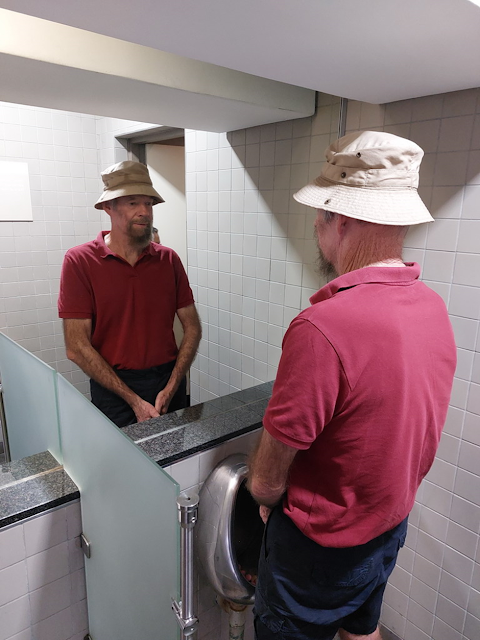
We wandered through the grounds and examined the outbuildings where the dramatic events had taken place, and then looked for a public toilet before returning to the car. A rough brick building that once served as a store had been converted into a modern, well-appointed ladies and gents. I entered the cool interior and stood at the stainless-steel urinal. I had almost finished emptying my bladder when I glanced up and was startled to find myself face to face with my own reflection. There I was, holding my old organ and pissing into the silver receptacle. How extraordinary! Never before had I encountered such a feature in a public convenience. I was actually watching myself urinate! This was a brand-new experience, and it called to mind the labyrinthian mental game played by Borges in his short fictions. It was entirely feasible for someone to stand in the doorway and not only see me from both rear and front, but also to watch me watching myself, and at the same time me noticing the observer behind me. For a brief moment I imagined the arrival of a tall black man dressed like a gardener. He caught my eye in the mirror, glanced down, and said something in isiXhosa, which I took to be both humorous and mildly insulting. Then he was gone.


"Where to now, Guy?” I asked from the back seat as we drove away from Liliesleaf Farm.

“Alexandra township.”

“Ah, that should also be interesting. Hope we don’t get hijacked.”


To view my longer work as an author, you can find me on Smashwords here.

The Smarty Solution

    (Image: Ideogram.ai)     Let’s face it: growing old is a miserable story. Take for example one old toppie who thinks he ha...