Wednesday, March 27, 2024

How to Move a Deceased Relative's Possessions from A to B


The relative who died was AZ, my wife K’s youngest of two sisters. She died unexpectedly in London, leaving K and IZto sort out her affairs. It was known that AZ had property in storage in Cape Town, and on enquiry it was found that the rental payment for the storage unit was six months in arrears. Xtra Space politely informed us that, condolences aside, they would not release the contents of Unit O4 until they were in receipt of R16000. After some telephonic back-and-forth, the 16 was dropped to 12 and finally to rock-bottom 10 take it or leave it.

First, we had to make an exploratory trip to ascertain what had been stored for several years at considerable expense. We picked up N and continued on over the mountain to Stink Kaap. Xtra Space was located in an industrial area near the airport and we found it without much difficulty. The woman in charge used a pair of bolt cutters to cut the overlock and allow us to open the tip-up door. The store was half the size of a single garage and it was jampacked with what looked to me like an assortment of worthless household junk. On opening the top drawer of a rusty filing cabinet, however, we found it was crammed with folders containing a multitude of black and white prints as well as sheafs of negatives. This was the treasure trove I had been hoping to unearth.
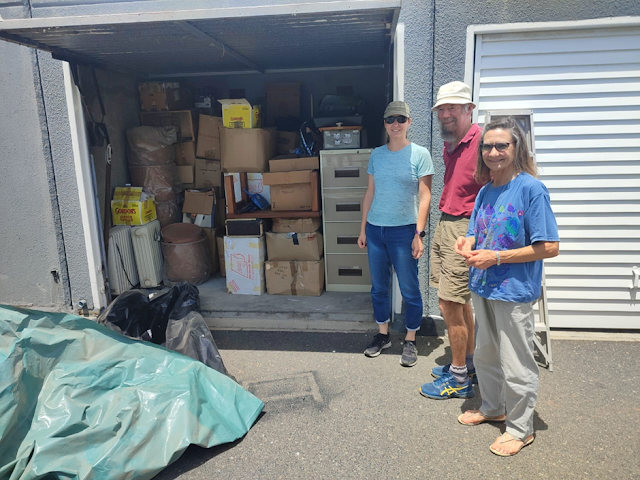

The next day, Thursday, K made the payment and bright and early Friday morning she was reversing the Venture into N and A’s driveway in Kleinbaai. The small trailer was hitched up to our vehicle and they led the way in their ageing Land Rover to the trailer hire place in Gansbaai. An alarm bell went off in my head when we arrived and were informed that the sturdy double-axle trailer N had booked was unavailable, its spare wheel having been stolen in the night. Instead, we would have to make do with a single-axle version that looked like it had originally been drawn by oxen.

Over Sir Lowry’s Pass we went and on the other side called in at the first filling station for a piss stop. While parked round the side, a car pulled up behind us and a man got out in a hurry, looking like he was both happy and excited. N seemed to recognise him and they had a brief conversation before he waved goodbye and departed.

“Pike,” she said, and handed me the man’s card.


This is what makes life worth living. The miraculous appearance of one of Pike’s representatives, like a guardian angel come to check up on us, was both comical and reassuring. It was a reminder that we are not alone in this world, and that we should never give up hope because, even in the direst of situations, fate is capable of taking an unpredictable twist. Not that I believe in fate, or guardian angels, or any of that shit, but I was genuinely delighted and amused that Pike had once again swooped down upon us.

“What did you tell him?”

“The usual. You’re not interested in selling, but if you change your mind, you will contact him.”

We arrived at Xtra Space at 11.30 and, after a delay while they checked to see if the EFT had gone through, we set to work loading up the Venture and the trailers. It was hard labour, and would have taken twice as long without A. He is built like a sumo wrestler and is capable of feats of prodigious strength.


Long before the store stood empty, I had begun to feel waves of trepidation and in need of something to calm my nerves. By the time the last items were piled onto the big trailer, its springs were almost flat and the chassis cleared the wheels by no more than an inch. I couldn’t see how we were going to make it out of the gate and into the road, let alone go all the way to Gansbaai. To my amazement and growing sense of relief, however, we reached the N2 without incident and pressed on, the Land Rover leading the way.

It was after 2 on a hot Friday afternoon, and the traffic was already backing up as we approached Somerset West.

“This stop-start crap isn’t good for his clutch,” I said.

We made it through three sets of lights when, uh-oh, he began to drive in the emergency lane. We also pulled to the side and cars overtook us. The flow of traffic was beginning to speed up, which was encouraging, because it meant we would be able to get a run at the pass, if only the Rover’s clutch held out. Halfway up the first long incline we ground to a halt. Five minutes elapsed and then we heard him revving the engine, and again we were on our way. Round the hairpin bend we crawled before having to take another breather. We had started on the steepest stretch and cars were passing us at a steady rate. K was looking anxious, and she later said it was then that she contemplated offering up a prayer. Once a Catholic, always a bloody Catholic. Three hundred metres from the top of the pass we slowed to a walking pace and I was suddenly struck by the memory of a scene from John Steinbeck’s The Grapes of Wrath. We were like the sharecropper migrants, piled up with our worldly goods struggling to reach the promised land in an overloaded jalopy.

This, I thought, is what it must feel like when making the final ascent on Mount Everest with the weather closing in. Would we make it, or would the expedition end in disaster?

The intrepid driver and his navigator coaxed the flagging old Rover up the last few metres and, to our immense joy and relief we followed them over the summit and began descending into the land of milk and honey.

“Now he can coast for a bit and rest that clutch and clapped-out engine.”

“But not for long,” my wife said. “There’s that hill to climb after the dam.”

“Ah, that’s nothing.”

Like fuck, it was nothing! Halfway up he was driving on the verge, slower and slower until all progress ceased. K turned off the engine and we sat listening to the traffic rushing by, and watched the long grass at the side of the road waving in the wind. After about five minutes N got out and came and stood at my open window.

“Looks like that’s it,” she said. “We’ll have to get a tow.”

It now emerged that it wasn’t just a diseased clutch that the aged vehicle suffered from. Why the engine kept losing power was because it was being starved of fuel.

“Dirt in the tank,’ N explained. “It’s the petrol we got from those fuckers in Kleinbaai. We will have to call for a tow truck.”

She went back to A and after ten minutes returned. For R4500 a tow truck with flatbed would get the Land Rover and trailer to Gansbaai. K and I looked at each other in dismay. This was proving a very expensive operation, but there was no alternative. When the outfit arrived she would make the EFT. N gave them the go-ahead and said they promised to be with us in half an hour.

More than half an hour elapsed and she was on the phone again.  Twenty minutes. N and A were standing beside us, anxiously watching the stream of cars coming up the hill. Still no tow truck, and then a car pulled up behind our little trailer.

“That bloody Pike again!”

She went and spoke to the man, and when he headed off he gave a cheerful toot-toot and a thumbs-up.

“He’s on his way back to Swellendam, and he’s oh-so-happy it’s not the Venture that’s giving trouble.”

A was looking grim, as if he needed to get into a brawl. He muttered something to N and stomped back to his troublesome work horse.

“He says he is not waiting any longer for those lying bastards.” We heard the engine start up. “I had better move it, or he’ll go off without me.”

From there on the Land Rover chugged along at a steady 80 all the way to Kleinbaai without stopping once. It was later agreed that the protracted wait had allowed the sediment in the tank to settle and thus the fuel supply had kept flowing uninterrupted.

As for the tow truck, K and I admitted to feeling a twinge of guilt at not having waited for them, but agreed it was not worth losing any sleep over, as these scavengers were notorious crooks and liars and did not deserve any sympathy. And R4500 was a rip-off we could do without, anyway.

We stopped at the OK in Gansbaai to buy a few groceries and it was well after six by the time we reached Kleinbaai. N and A were already unloading the contents of the trailer into their double garage. We slaved away for more than an hour emptying the trailers and the back of the Venture, and I again marvelled at A’s strength, shuddering at the thought of having had to accomplish this mission without his and N’s help.

Finally, we were done, and all that remained was for the big trailer to be returned to its owners, and for K and I to get back to Pearly Beach. It had been an exhausting and stressful day but, with a great deal of luck and help from our guardian angel we had managed to move our deceased relative’s possessions from A to B without mishap. hallelujah!


To view my longer work as an author, you can find me on Smashwords here.


Monday, February 19, 2024

The Treaty Tree


On the pavement there was a man lying on his side with his legs drawn up. Snoring loudly, he lay with his cheek pressed to the paving slab, his open mouth a slack hole. One arm was tucked under him, elbow jutting behind, in front his hand palm up. The other arm was bent prayer-like, the hand laid palm down on the pavement before his face. He was lost in the grateful oblivion of the dead drunk. Henry stepped round him and crossed Albert Road.

Treaty Road was a narrow side street marked by a church school on the corner. Grimy and dilapidated, the school blended in with the surroundings. Pausing, he looked up at the wall and contemplated the cross surmounted by the name of the school. He sought for an apposite phrase. Did the cross merely symbolise 'Church', or did the locals regard it as signifying something more complex and abstract like, 'the love of Christ', or, 'the pain and suffering of mankind?' What of Promise, Justice and Goodness? Did any of them regard it with bitterness as a symbol of 'superstition and ignorance'?

A gust of paper and grit blew across the street and he hurried on. Although the clouds were few the blustery southwest wind robbed the afternoon sun of its warmth.

He saw no sign of the tree. The road seemed to end at a set of rusty gates in a wall of crumbling brick that surrounded a half demolished warehouse. Beyond lay the railway tracks, a factory and the docks. When he approached the gates he saw that the road turned to the right and followed the wall. There at the end was a tree.

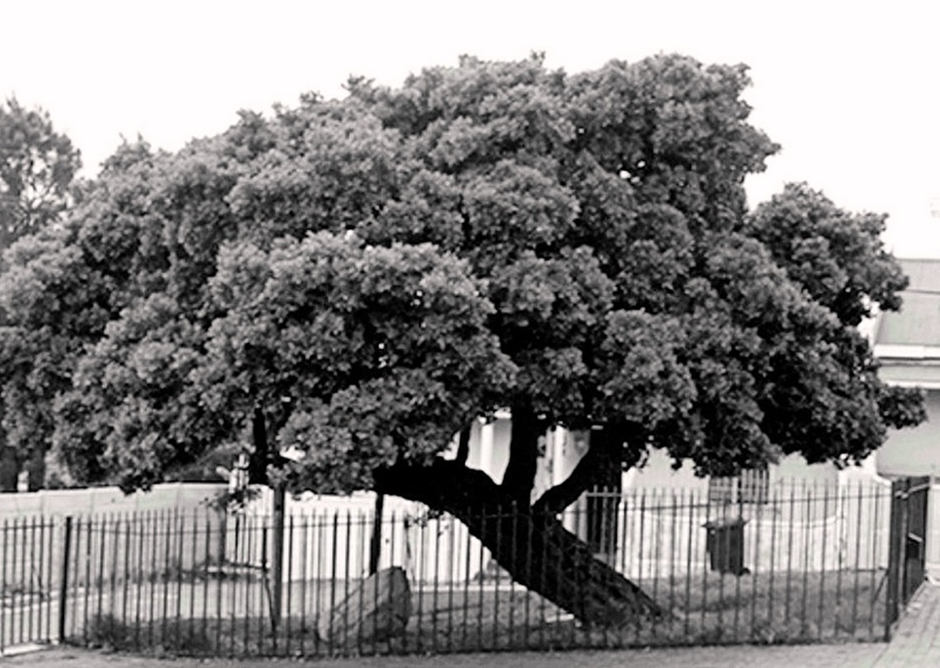
He had seen the white milkwood at Mossel Bay, the Post Office Tree. Huge, gnarled and ancient, maybe six hundred years old. The Treaty Tree was not as impressive, though its thick, twisted trunk was evidence enough that it had been standing there for some three of four hundred years. He admired the dense foliage, the rich dark green of the shiny, rounded leaves. The tree was protected on one side by a wall in which was set a brass plaque proclaiming the monument. Next to the tree had stood a house where the commander of local Dutch defences had formally handed over the Cape to the British after the Battle of Blaauwberg in 1806.

He tried to imagine how unspoilt the area must have been in 1806. Low dunes with grass and yellow flowering sea pumpkin, and sails in the bay. Now look at it. The plot of grass where the house had stood was kept neatly mowed by the Council and there was a park bench. But the view beyond was grim. The ugly utilitarian shape of a warehouse made more unsightly seen from the rear, a derelict site littered with rubble and refuse, the long, crumbling brick wall.

He turned from the tree and was confronted by a coloured woman. He had not noticed her approach.

"Master, gee vir my 'n sigaret. Asseblief, Master."

"I don't smoke" Henry replied.

She looked about thirty and wore tight black pants and a dirty blue cotton coat. Her hair was concealed by a woollen cap. She had a shapely figure but her face looked raddled and puffy. She carried a plastic bag and he heard the clink of empty bottles.

"You don't smoke, Master? I'm a smoker. I'm also a drinker." She giggled. She was probably drunk: there was an aggressive air about her. He began to move off. "Give me ten cents, Master. Vir 'n dop"

He shook his head. He tried to imagine the kind of life she led.

"Do you know about this tree?" She looked blank. "Did you know that this is the Treaty tree?" She eyed him suspiciously.

How remote she is from me, he thought. Of course she knows nothing of the tree. It was a tree. What did she care?

"You want to come with me?" She asked, gesturing towards the wall. He was a little surprised and began to walk away. Bound to be diseased, anyway. Then out of curiosity he turned.

"How much?"

"Five rand." He laughed. She came and stood close to him. "Net twee rand." She was dark skinned and her face was marked. He could smell the wine on her breath and see the offensive boldness in her eyes. "Net twee rand. Kom jy?" She was slightly impatient.

Henry made a motion with his hand and she understood. He followed her to a point where there was a break in the wall. There was nobody in sight. She led the way to the partly demolished building and they passed through a doorway into a room that had four walls but only the sky above for a roof.

How easy to do the wrong thing again. No clamour of warning in his head. Merely a vague idea that this was not the right thing. No intuitive surge of feeling to counteract the rising curiosity, excitement, and sexual urge. Just a faint, toneless voice disinterestedly making a statement: wrong. How unpersuasive.

His heart was thumping fast and he felt shaky in the legs. She turned round and put down the bag, the bottles rattling together on the cement floor.

"Kom" she said, smiling to reveal two missing teeth. Henry unzipped and lowered his trousers and she began.

Henry was particularly excited by the darkness of her hand, the contrast of brown against white. She was expert and unhurried and he stood leaning against the wall, arching his body back in sacrificial abandonment. Then he clutched her hand holding it down, hard.

Henry gave her the money and hurried away, wondering why he felt so unashamed of himself.


Why did I do it? It was such an easy defeat. I don't' think I put up any resistance at all. Possibly I didn't even realise I was being attacked. But then, what was wrong with it anyway? A minor incident in the daily economic life of the city. A straightforward transaction between two persons, one providing a service, the other, the consumer, paying the agreed price upon satisfactory delivery of said service. No coercion, no exploitation. No exploitation? Well, of course there was exploitation. I exploited the vulnerability of a 'fallen woman' and paid her to perform yet another demeaning act, thereby further undermining what was left of her self-respect and regard for her fellow beings. But what if she had come to Palmerston Road and knocked on my door and offered to clean the windows for two rand? If I had then given her the choice, clean the windows or milk the bull for two rand, I'm sure she would have gone for the bull without hesitation. Ho-hum, who am I trying to deceive with this specious bluster, this beating about the bush? There's no necessity for an ethical debate - in my own eyes, according to my own values, according to my own notion of how human beings should treat each other, my action was plainly immoral. Instead, what I should be trying to determine is why I repeatedly succumb to the wrong impulse. Maybe the initial impulse can be ascribed to my active imagination and openness to novel or exciting situations. A dilettante's unencumbered disposition at play. But the conception of possibilities should be accompanied by judgement and choice. The moment the migratory thought of hiring the woman's services crossed my mind an alarm bell should have sounded. A neon sign should have lit up proclaiming a bold warning. Something like ACHTUNG, or WATCH IT, PAL, or PAS OP VIR DIE GEVAAR. Without a moment's hesitation that clear warning should then have been heeded. I should have immediately turned my back on the temptation, discarded the impulse and walked away. For my own physical safety and peace of mind it should become an unquestioning habit, as automatic as a conditioned response in a laboratory rat. I see the danger; I don't even think about it; I just walk away. And to hell with the voices extolling life as an open-ended adventure and deriding the insipid gentility of virtuous action.


Taken from The Life of Henry Fuckit

To view my longer work as an author, you can find me on Smashwords here.


Monday, January 1, 2024

To Hell with Future Generations


The 2023 Annual General Meeting of the Pearly Beach Conservancy was held at Klein Paradijs on 19 December. Twenty-three people were in attendance. The Chairperson opened with a quote from a Native American source that went something like this: “We do not inherit the Earth; we borrow it from future generations.”

The minutes of the previous AGM were approved and the Chairperson reported on the achievements of the Conservancy over the past year. A new committee was elected and the meeting ended with informal conversation over refreshments. The Chairperson who, with her husband, is the owner of the Klein Paradijs farm, then offered to take those who were interested on a guided walk. A dozen or so members followed her on a circuitous route past a dam and up into the mountain fynbos before returning to the homestead.

The one-and-a-half-hour ramble was informative, the indigenous vegetation was in prime condition and the view out over Pearly Beach to the sea put the whole area into perspective.

Back at home, I went over the outing in my head and was struck by two observations. The first had to do with the neighbouring property to the west. A wire fence marked the boundary between low fynbos and a dense forest. Tall Myrtle trees had swallowed up all other vegetation on the adjoining property. The contrast was startling, and I again realised that only through human intervention will the invasion of alien species be kept in check. This is a depressing idea, because it means that we have to live with a constant threat from a situation that is of our own making, having intentionally introduced these plants from Australia over a century ago.

The second thought that occurred to me stemmed from the fact that at the meeting there had not been a single person under the age of sixty. My wife and I were among the founding members of the Pearly Beach Conservation Society back in the mid 1980s. We were in our thirties, and the other members were of a similar age or in their forties. I don’t think there was anyone much older than 60. So, what has changed that younger people appear to have little or no interest in Conservation?

When I consider how disastrous the past 40 years has been for the natural environment, and how bleak the future looks as the effects of Climate Change accelerate, I am puzzled by the apparent apathy on the part of the youth and parents of young children. Are they not capable of imagining the future that lies ahead? Why are they not motivated to do something to slow the process of environmental degradation? Is it out of ignorance, or lethargy, or even despair that they show no interest in supporting their local Conservation group?

After struggling with these questions for a while, I was suddenly struck by a novel consideration. Although I endorse the noble sentiments of the Native American elders, and will continue to support the work of the Conservancy, there is no point in worrying about succeeding generations. If young people are too stupid or self-absorbed to care about the future quality of life on this planet, why should I bother myself with their predicament? And, anyway, I won’t be around to face it with them. No, when they and their kids are choking to death in the toxic smoke from an apocalyptic inferno, they will only have themselves to blame.

With that liberating thought, I felt justified in pouring myself a glass of wine and retiring to the stoep to watch the birds and tortoises coming and going, and to enjoy the feeling of relief at having a weight off my mind.

To view my longer work as an author, you can find me on Smashwords here.

Wednesday, December 20, 2023

Somebody Is Trying to Kill Me


This latest episode has confirmed my suspicion that I am on the way out. It could still take some years to get there, but I have the impression that the journey is now well under way.

It started in 2016 with prostate cancer; then there was the squamous cell carcinoma on my cheek followed by that stupid hernia. The thing on my cheek somehow evaded the old boy’s scalpel and got to work on the nearest lymph node and had to be attacked with chemo and radiation a year ago. A couple of months later more sc carcinoma, this time on my ear, and it was back to the octogenarian plastic surgeon to have a chunk cut out, Van Gogh style. Better luck this time? And now the heart.

A heart murmur was picked up when I was a youngster, and the Army did not want me because of it, for which I was thankful. This murmur kept to itself until about two years ago, when it suddenly raised its voice to a shout. It was like having a panic attack. My heart pounded at a furious rate and I felt light-headed and in danger of fainting. I had to sit down and wait for the episode to pass, which it gradually did over the next half hour.

Since that first incident I have had three or four bouts of varying duration, none of them lasting more than an hour before the hectic pumping slows and my pulse returns to normal. This latest episode, however, was far more serious. I was working in the garden when I felt it coming on. My heart beating rapidly, I went inside and sat down, waiting for the thumping to slow and subside. By the evening I realised I was up against a different beast that showed no sign of buggering off and leaving me alone.

The following morning – it was Wednesday, 6 December – I got out of bed and the pounding resumed, as did the dizziness whenever I stood up. Christ, I said to my wife, we had better do something about this. Alarmed, she sprang into action and phoned the physician I had consulted previously. At the time, he had been unable to make a definitive diagnosis, saying it was like taking a car to a mechanic. While it is running smoothly, it is hard to say why it sometimes cuts out. He now advised me to make haste to my GP in Gansbaai and get her to give me an ECG and send it to him, pronto. We drove to Gansbaai, where the GP had agreed to wait, even though she had seen her last patient. After battling to get electrodes to stick to my hairy chest, she managed to do the ECG and send it to the physician. Back in Pearly Beach, the phone rang and the physician informed me he had made an appointment for me to see a cardiologist in Hermanus at 2pm the next day.

The cardiologist turned out to be a thin woman of about 60. She had a direct manner and I found her line of questioning interesting, as it seemed to reveal something about her as a person who was more than just a medical professional. She took me to her ‘workshop,’ a room with a bed and monitors and various pieces of electronic equipment. I lay down and was once more wired up for an ECG. Then she used a small hand-held device placed over the area of my heart to see what an ultrasound would reveal.

“I’ll turn up the Doppler so you can hear how fast your heart is beating,” she said, and I listened to the rapid beeping that sounded to me like a terribly urgent alarm going off. Around 200 beats a minute. No wonder I felt like I did. “What you have,” she said with conviction, “ is an Atrial Flutter.”

The next step was to take me to a nearby emergency room where a doctor and three paramedics immediately went about setting up an IV line in each arm. I got the impression they were treating this as a life-threatening situation and there was no time to stand around chatting. First, they attempted to slow my troublesome organ by administering a drug intravenously. This had next to no effect and, after trying once more in vain, they all agreed, including the cardiologist, who was directing operations, that it was time to bring out the big gun. A large electrode was stuck to my chest and another on my back. They were going to shock my heart out of its crazy rhythm and bring it back to normalcy. But first they had to put me under, and again I had the pleasure of drifting into unconsciousness. Told to count aloud, I got to 28 or 29 before my voice faded and I returned to the womb.

Minutes later, I was back in the emergency room, fully conscious and aware that my heart had slowed from a gallop to an amble. The cardiologist was clearly pleased that the cardioversion had been successful and she did not have a corpse on her hands. She said I would have to remain in ICU overnight to be on the safe side, but unfortunately the Mediclinic facilities were choc a bloc with all the bloody senigrants who had been pouring into the area. I would have to be taken to Vergelegen in Somerset West. This meant being loaded head first into a crappy little ambulance and taken on an hour-long journey over the mountain, and then offloaded the other side and trundled along endless corridors to the high care ward.

The next 12 hours felt like a form of torture. I was rigged up to an ECG  and a blood pressure aand pulse monitor on one side, and an IV drip on the other, which restricted movement in the bed that soon began to feel like a rack. I was walled in by curtains, beyond which I was aware of other patients. Throughout the night there was a great deal of coming and Going all around and within my chamber, and the noise of beeping monitors, loud voices and clattering equipment was constant. For supper I was served tea and a white bread, cheese and tomato sandwich which, if I was the complaining type, I would describe as unappetizing. I could not get comfortable and doze off, so I remained fully aware of the ordeal I was going through. At one stage I asked the nurse, who was most attentive and gave me the impression that she expected me to have a heart attack before she went off duty, whether I could go to the toilet. Definitely not, If I wanted to empty my bladder she could help me to use a bottle. She unplugged some of the equipment and helped me stand at the side of the bed. Once she was sure my old dick had been thrust into the cardboard urinal, she left me to relieve myself in private. At 4.30 she wheeled in a trolley bearing a bowl of warm water, soap and a towel, and said it was time to bath. Bath? I washed my hands and wiped my face, neck and armpits, and lay back, listening to the commotion going on around me and waiting for breakfast.

The day staff came on at 7, and breakfast arrived at 8. A container of yoghurt, scrambled eggs and toast. And, strangely, a small bowl of mincemeat. It made me think of gruel, the likes of which might have been served to the patients in Bedlam. It tasted alright.

At around 8.30 my cardiologist’s colleague arrived. In his late fifties, he was affable and unhurried. He looked at the file and asked me how I was feeling. Desperate to get out of the place, there was no way I was going to say anything but fine. Good. He called for a discharge form and wrote me a script for a blood thinner, which he said his lady would motivate for chronic with the Medical Aid. He confirmed that my problem was Atrial Flutter and assured me it was not an uncommon condition with the elderly, and could be treated successfully by means of ablation. This technique uses heat or cold energy to create tiny scars in the heart to block irregular electrical signals and restore a typical heartbeat. It is performed by passing a thin catheter through a vein or artery from the groin to the heart. It does not involve major surgery and the patient goes home the next day.

He left me with these comforting words and I immediately phoned my wife to come and fetch me in Somerset West. Our hospital plan only paid for one-way ambulance transport and Discovery weren’t interested in how I got home, just as long as they were not asked to foot the bill.

She made good time and arrived soon after eleven. The road all the way to Hermanus seemed excessively busy and we agreed that, like my heart, the pace of life was becoming too fast for us. When I got out of the car in Pearly Beach and heard the birds in the garden and smelt the sea on a gentle breeze coming from the south I nearly wept with joy and relief. I was lucky to have survived a hellish interlude in an increasingly hostile and alienating environment.

In a month from now I must again go over the mountain, this time all the way into Cape Town, to undergo the procedure that will allow me to live to a hundred, if I don’t die tomorrow or the next day, depending on who or what is waiting in the shadows to jump out and kill me.


To view my longer work as an author, you can find me on Smashwords here.

Thursday, November 16, 2023

World Toilet Day


When it was brought to my attention that November 19, my birthday, has been designated by the UN as World Toilet Day, I was mildly offended and thought that they had a bloody cheek choosing that particular date. Out of curiosity, I decided to investigate further and was appalled to learn that, of the 8 billion humans on this planet, 3.5 billion of them live without safely managed sanitation, and 419 million people practice open defecation, open defecation being the polite term for shitting on the ground. According to the United Nations, the world faces a sanitation crisis involving the spread of disease and increasing degradation of the natural environment. If the seriousness of this situation is not recognised the world will fail to meet Sustainable Development Goal 6, which aims to provide toilets and safe water to all by 2030. I thought about this for a bit and wondered what I could do to make a difference, even if only in a small way. It was then that I had a brainwave and I sprang to my feet.

From the newspaper box I took an old copy of the Cape Times and went outside, closing the door behind me. I didn’t want the dog following and making a nuisance of herself. It was going to be a warm day, the sun was already high, and I was glad to be wearing a hat.

The indigenous bush has grown up on the adjoining plot to form an unkempt fynbos garden. A path snakes through the low but dense vegetation to a clearing near the centre of the property. I passed a tortoise coming my way, and then disturbed a family of francolin trying to take a dust bath. 

In the clearing I set the business supplement to one side, then opened the main section in the middle and spread it on the ground. Stepping out of my Crocs, I removed shorts and underpants and draped them over a bastard olive. Then I moved onto the newspaper and squatted down.

I didn’t have more than a few moments to wait. A single fart heralded the imminent arrival, my sphincter relaxed, and the faecal serpent slithered from my colon, where it had been waiting with growing impatience. Beyond my dangling genitals I could see it settling itself on the newspaper in a rich brown coil of potter’s clay. The familiar odour of my excrement filled my nostrils in a way that I found extravagantly offensive. 

Well, I thought, as I tore a strip of paper off the Business Report, that was easy enough. But, directing a stream of yellow urine away from the Cape Times and enjoying the feeling of relief as my bladder emptied, I accepted that it was time to deal with the consequences.

Wiping a hairy arse can at times prove to be a messy affair, even when using good quality two-ply. Newsprint is nowhere near as absorbent as toilet paper and tends to smear rather than clean. I would hate having to contend with this mess every time I had a bowel movement.

Fully clothed once more, I was obliged to deal with the next essential stage of the ritual, which was to dispose of the repugnant product lying there on the ground. I lifted the nearest edge of the Cape Times, which was a little soggy, and folded it over in order to cover the heap. Then the back edge forward and the two sides in. I picked up the parcel, weighing it and feeling its warmth, and realised with annoyance that I should have first spread the Business Report, ready to receive the wrapped waste matter. Now I had to set it to one side, spread the supplement, and fold the Times in on itself once more before bundling it in the additional sheets.

Back at the house I dropped the bundle into the black bag lining the dustbin and replaced the lid. Washing my hands in the bathroom, I congratulated myself on having accomplished exactly what I had set out to do. I had experienced firsthand what 419 million people are faced with every day.

Now, having recorded my performance in writing, I would like to encourage all my readers, men and women, young and old, to follow my example and set aside half an hour on 19 November in order to squat in solidarity with all of the unfortunate people who do not have access to decent sanitation.

I urge you to humble yourself and go out into the garden, defecate on a sheet of newspaper and dispose of it in the dustbin as I have indicated. By doing so, you can help to make this become a worldwide movement that will raise awareness and bring about meaningful change.

(If no garden space is available, I suggest the garage as an alternative. Failing that, it will have to be in the house, preferably on a tiled floor.)


To view my longer work as an author, you can find me on Smashwords here.

Friday, October 27, 2023

The Treatment

My deteriorating eyesight forced me to give up driving twenty years ago. This has made me dependent on my wife and, to a lesser extent, my daughter, should I ever need to leave Pearly Beach, and that is why I could not travel back and forth for cancer treatment on my own.

The treatment started on Monday, 31 October, 2022. We left pearly Beach at 1.45pm, allowing sufficient time for delays through the road works between Gansbaai and Stanford in order to be at the Centre by 3pm. After visiting the spotless grey and black tiled facilities with their gleaming white receptacles, we found Pathcare just round the corner. There were no other patients and it did not take long for a nurse to draw a small quantity of blood from my arm and stick a pledget over the puncture site.

At Radiology, I had barely seated myself on the sumptuous black leather couch when MelanĂ© and Rochelle arrived and greeted us in a friendly fashion and we descended to the bunker. They showed us the control room from where they monitored the procedure and then took us into the radiation area and explained how I would lie on the table with my head immobilised in the plastic mask and be remotely moved into position beneath the equipment. This, they said, was a linear accelerator programmed prior to each session to deliver high-energy X-rays that conform to the specific size, shape and location of a tumor. In this way, the LINAC could target and destroy cancerous cells in a precise area of a patient’s body with minimal exposure to the surrounding healthy tissue.


Before lying on the table, I was asked to remove my shirt so that the mask fitted snugly over my shoulders. On seeing the scrawny condition of my torso, Melané registered something bordering on horror, and she urged me to eat more protein and start taking food supplements. I later realised that her concern was informed by the knowledge that I would soon be losing weight. I climbed onto the table, was strapped into the mask and they retreated to the safety of the control room. I lay listening to the hum of machinery and wondering whether I was going to have a panic attack.

I heard some whirring and clicking and assumed the radiation head was rotating above me and taking up position to target the tumour. The table jolted, there was more whirring and clicking, and after a few minutes a loud buzz as the actual zapping began. It lasted some ten to fifteen seconds, ceased, and then was repeated another three times with intervals of about two minutes. I heard the head move back to its original position, and then the sound of the door opening and footsteps approaching. The therapists were either side of me releasing the mask from its anchor points and asking me if I was okay. The table was moved out and lowered, and I was able to sit up and get to my feet. The process had lasted no more than fifteen minutes.

I ended up having a total of 32 radiation sessions over a period of almost seven weeks. In that time, Melané, Roshelle and Karien were extremely supportive and seemed to genuinely care about how I was responding to the treatment as it progressed. The fourth member of the team was Michelle, the receptionist, and she proved to be friendly, efficient and helpful, even to the extent of trying to sort out a software issue on my phone.

The following day, Tuesday, we were back at the Centre for my 9.30 am appointment with Doctor D. He announced that my blood test was normal.  This was to be expected at this stage, but as treatment progressed it was important to monitor my condition and ensure that my white blood cell count did not fall too low as the chemotherapy took effect. The programme he had worked out entailed six or seven weekly chemo sessions, and 32 doses of daily (apart from weekends) radiation. Again, he briefly mentioned possible side-effects before taking us through to the chemo lounge to meet Aggie.

Apart from Carol, the tea lady and Sunelle and Martie., the pharmacists, there were three nurses. For some unfathomable reason, I came to think of them as the sisters of mercy. They were Aggie, Tania and India.

I was shown to one of the twelve black leather La-Z-Boy recliners and asked to place my left arm on a pillow for it to be covered with a warm towel. After allowing five to ten minutes for my veins to dilate, India removed the towel and went about inserting a canula and connecting me to a litre bag of prehydration fluid hanging from a mobile drip stand. Attached to the drip stand was a monitor that began beeping a warning when there was a hitch, or the bag was about to run dry.

Prehydration took about an hour and a half, and before the next phase could commence, I was to prove myself ready by passing at least 300ml of urine. The chemotherapy drug was administered from two 400ml bags, one after the other, and took a further hour and a half. The drug that I was given was Cisplatin, which attacks rapidly dividing cells like cancer and, in combination with radiotherapy was designed to destroy the malignancy that was intent on killing me as soon as it could.

As Doctor D had warned me, Cisplatin came with unpleasant side-effects, and to counter them I was given a cocktail of pills to be swallowed before and after meals. Omeprazole was an antacid, and for nausea there was Aprepitant, which was also meant to stimulate the appetite, Prednisone, Granicip and Contromet. They proved effective in that I never felt outright nauseous, and I never threw up in spite of a growing aversion to almost all food and drink.

Tea or coffee was on offer and was always accompanied by a ginger biscuit, ginger being a nausea antidote. However, by the fifth week even this confectionary had become unpalatable.

These three-hour chemo sessions were not too tedious because patients came and went and provided a degree of interest and entertainment. I regularly got to chat to one man in particular. About my age, he was also receiving radiation as well as chemo. Cancer was eating up the fingers of his bandaged right hand. He tried to show me what the wound looked like on his phone but, unable to see any detail I had to use my imagination to appreciate the gory spectacle. Intelligent and outwardly cheerful and positive, he had an irreverent sense of humour that reminded me of my father, and I was grateful for his company.

And there were the nurses, of course. When there were half a dozen patients or more, they worked under extreme pressure, setting up and disconnecting drips, and responding to the frequent beeping of monitors. Nevertheless, they were always cheerful and unflustered, and even managed to chat and banter with their more extrovert charges. The atmosphere was never gloomy, despite the seriousness of the incurable illness each patient was contending with. I asked India if she found the work distressing, and she said she enjoyed interacting with her patients and getting to know the individual, even if it was only for the duration of their treatment. The distressing part was when news came that they had lost someone before the end of their course.

Observing the nurses and the radiation therapists at work, my indignation and anger on encountering injustice was rekindled. How is it, I asked myself, that a society can support a system that rewards self-interest, materialism and greed far more generously than altruism and dedication to alleviating suffering? There has to be something fundamentally wrong with such a status quo but, I told myself, there is nothing much I can do about it, and must confine my feelings to gratitude and admiration for all of those working in the health care profession.

Next: The Side Effect


Other posts chronicling my encounter with cancer:

The Lead Cylinder and the Plastic Urine Sieve 

One Thing Leads to Another

An Aggressive Uptake of Glucose

The Man in the Plastic Mask


To view my longer work as an author, you can find me on Smashwords here.

Sunday, October 15, 2023

How Not to Pour a Cup of Tea

This is an extract from The Life of Henry Fuckit:


Of course, it is worse when I am acutely anxious or fraught with existentialist depression like the other day when I was at home in my filthy little chamber at the Olympia Residentia and it was late morning and I thought I'd make myself a nice pot of rooibos tea to steady and comfort myself because I was feeling very shaky for some obscure reason, finding life rather unbearable and feeling rather overwhelmed by the pain and humiliation all around me wherever I looked. So there I was trying to pour myself a cup of tea. As I say, I was at a very low ebb and floundering in a slough of insecurity and self-loathing. My intention was simple and mundane, merely wanting to pour a cup of tea, but as I lifted the teapot I was filled with embarrassment and misery at the spectacle of my hand upon the handle, it looked so weak and ugly. It was bony and the knuckles were white like gristle and it was a weak hand and the skin was red and blotchy and ever so ugly. The hand quivered and shook and the tea came out in a feeble, wavering stream that cut me to the quick. Right to the very core I was cut, bleeding and raw and weeping inside. It was a direct attack on my integrity, my very persona, this pitiful stream. It was like an old drunk pissing, uncertain and erratic. This wasn't rooibos tea, this was piss darkened with blood, and MY piss would be like this soon, a tincture of blood and piss in stinking fish water. Miserably I regretted trying to pour the tea. I shouldn't have poured the tea; I should never have tried to pour the tea. What right did I have to try and hold a teapot steady and aim a steaming spout at a gaping cunt of a cup? Instead I should have crawled under a blanket and crouched there under a blanket in the dark, shaking and trembling inside and wanting to whimper. Why, I asked myself, why am I like this, how has it come to pass that I am like this? This is what I asked myself there in the room, in my hour of dejection there in that anteroom waiting to be summoned into some frigid abyss. Why am I like this, I kept asking myself, why am I like this? I don't know why I'm like this. I couldn't drink this pernicious decoction, this foetid infusion. I wouldn't drink it. No ways. The more I thought about it the more agitated I became. I blamed myself for my own despicable weakness, for I should never have tried to pour it in the first place, knowing what I was like, not being able to do anything right, not even the simplest of tasks. I was a shivering cur, better off with brains kicked in and guts spilled in the gutter. Oh, it was a very dark hour for me, I can tell you. Such debilitating wretchedness. That's why I'm so worried and am forever casting about, this way and that, looking for some kind of explanation, some definitive diagnosis that would help me to overcome what appears to be a relentlessly progressive malady.


If you enjoy this kind of piffle, you can read all of Henry’s monologue here.


To view my longer pieces as an author, you can find me on Smashwords here.

A Conversation with AI

    (Image: Ideogram.ai)   Are you more knowledgeable than any human? Not in the way a human is. I can access and synthesize a muc...