Tuesday, July 9, 2024

The Urinal at Liliesleaf Farm


We arrived in Joburg on Friday, 17 May 2024, and returned to Pearly Beach on Monday, the 27th of the same month and year, which makes the trip an 11-day odyssey. On Day 4, Monday the 20th, Guy took us to see some of his old haunts that we had heard about over the years, and then to Liliesleaf Farm. We went in Jen’s Kia Picanto, which she generously lent us, as she was working from home that day. I not only thanked her, but Christ as well, under my breath. Guy’s 1996 Honda Prelude is a very stylish sports car with a sun roof and a powerful 6-cylinder engine but, apart from being low on the ground, it has only two doors, and the back seat is designed to take a pair of dwarfs and not someone taller than about four foot six. When he picked us up from Lanseria on Friday, I had been required to ease myself in backwards and half lie in a contorted position with my feet behind the passenger and my upper body behind the driver. By the time we reached his complex in Linden my right leg had gone to sleep and I had bumped my head on the roof a dozen times.


Our first stop was the parking area on top of Bryanston Mall. On our way there it became apparent that traffic in Joburg moves considerably faster than in Cape Town, and Guy drives assertively. This is a style somewhere between defensive and aggressive, but definitely closer to the latter than the former. The Mall is situated on a ridge, and there is a fine view from the parking area. We stood at the concrete parapet and surveyed the city laid out before us. Now we could see why it is known as the biggest man-made forest in Africa, with most of the houses, chops and roads obscured by  a myriad trees. To the south, the high-rise buildings of Sandton stood tall above the surrounding greenery. It was around 11am on a mild, cloudless day without wind, and even the thin mantle of smog looked more decorative than toxic.

Next on the itinerary was Bryanston Crescent, where he had lived for five years before moving to Linden. Much different to what I had imagined, the place was set in large, park-like grounds surrounded by fortress fencing, of course. Blocks of flats, their design adventurously unconventional. Six three storey circular structures spaced comfortably apart, they probably dated back to the 60’s or 70’s, and looked solid and well maintained. Guy showed us the three-bedroom apartment he had rented, and it appeared far more salubrious than the den I had conjured in my mind in response to all the tales he had told us about the motley succession of dubious characters he had shared it with.


It was not far to Bantry Road, where he had lived for his first two years in Joburg. Again, it did not conform to the picture I had constructed, which was of a street in a flat area like Constantia. In fact, he had to exercise assertiveness in applying the hand brake when we stopped outside Number 29, or we would have rolled back downhill and crached into something.

This was the house of iniquity? We were looking at a gate that was designed to withstand any attack the barbarian hordes might launch in order to overrun the inhabitants of the fortified complex. Beyond the gate lay two rows of six duplex apartments facing one another across a paved driveway. Clearly, only respectable middle-class citizens could afford to live here.


“They demolished the old house, chopped down all the trees, and bulldozed everything, including the swimming pool and tennis court. Then they built what you see here. It’s happening all over the northern suburbs, this obliteration of the past. Only the address remains.”

He sounded wistful. Not a single detail had been left to trigger memories. For that, he would have to look for photos on his phone, or search his mental archive.

“So this is where Eric gave tango classes, and the Nigerian slaughtered a goat and cooked it on the kitchen stove for a week, and you threw fire crackers into the half empty pool to stop the cacophonous bullfrogs from destroying your sleep, and you shot at the rats with your air gun, and the sex addict paid the maid to give him a hand job between her sweeping and ironing, and your phone was stolen by that sociopath, and, and, and?”

I think he was chuffed that I had remembered these events that he had shared with us

From there we drove to Rivonia along River Road and stopped to look down into the valley that carried the Braamfontein Spruit, the longest stream in Joburg that empties into the Jukskei River to the south. The grassy slopes on either side of the tree-lined spruit had been mowed, and higher up overlooking the bucolic scene were the palaces of the wealthy class. On our side, above the road, was a similar line of prime properties, all of which were fronted by three-metre-high walls topped with electric fencing. It was unlikely that any of the tycoons, business magnates and captains of industry living in these mansions would be tempted to flog their residence to a property developer. But, as Guy told us, fashions and values change all the time in this city.

We reached Rivonia and stopped in a leafy street outside a light brown facebrick building that was low-rise and did not have the appearance of a city office block. Another surprise. This was where he had worked from 2011 until Covid and, like everywhere else we had been so far, the real Joburg was proving to be far more interesting than the monotonously unprepossessing environment I had constructed in my mind’s eye.

Now for Liliesleaf. It was not far, and the approach felt like we were in the countryside, and this could well have been a farm. The parking area was empty but, as we got out, a security man approached and said the resource centre was closed on a Monday, but we were welcome to walk around.


The farmstead was built on a slope, and the farmhouse and outbuildings look out to where fields and pastures once lay. As we wandered from one building to another, Krystyna read the information boards to me, and they proved most educational. To summarise what they had to say, I asked ChatGPT to discuss the history of Liliesleaf Farm and the events surrounding Mandela’s arrest. This is what it came up with:

Liliesleaf Farm, located in Rivonia, Johannesburg, holds a significant place in South African history due to its role in the anti-apartheid struggle. The farm was purchased in 1961 by Arthur Goldreich, a member of the South African Communist Party, and served as the secret headquarters of the African National Congress (ANC) and its armed wing, Umkhonto we Sizwe (MK).

Historical Background

  1. Acquisition and Initial Use:
    • Liliesleaf Farm was acquired under the guise of a typical residential property, intended to conceal the true activities taking place. Arthur Goldreich and his family posed as the white owners of the farm, which allowed black activists to operate discreetly.
  2. ANC and MK Activities:
    • The farm became a central meeting place for the leadership of the ANC and MK. Key figures such as Nelson Mandela, Walter Sisulu, Govan Mbeki, and Joe Slovo used the location to plan and coordinate their efforts against apartheid. Mandela himself lived on the farm under the alias David Motsamayi, posing as a gardener and cook.
  3. Operation Mayibuye:
    • One of the significant activities conducted at Liliesleaf was the drafting of "Operation Mayibuye," a detailed plan to transition from non-violent resistance to an armed struggle against the apartheid regime. The document outlined strategies for guerrilla warfare and mass mobilization.

Events Leading to Mandela's Arrest

  1. Increased Surveillance:
    • By the early 1960s, the South African government had intensified its crackdown on anti-apartheid activities. The ANC and MK's activities were under increased surveillance by the apartheid state's security forces.
  2. Mandela's Capture:
    • Prior to the raid on Liliesleaf, Nelson Mandela had already been arrested on August 5, 1962, while traveling from KwaZulu-Natal to Johannesburg. He was charged with inciting workers' strikes and leaving the country illegally. His capture was a significant blow to the anti-apartheid movement.
  3. The Raid on Liliesleaf Farm:
    • On July 11, 1963, the South African police raided Liliesleaf Farm. During the raid, several high-ranking members of the ANC and MK were arrested, including Walter Sisulu, Govan Mbeki, Raymond Mhlaba, and Ahmed Kathrada. The police uncovered a cache of documents, including "Operation Mayibuye," and other incriminating evidence that detailed the ANC's plans and operations.
  4. Rivonia Trial:
    • The evidence seized during the Liliesleaf raid led to the infamous Rivonia Trial, where Nelson Mandela and other key leaders were tried for sabotage and conspiracy to overthrow the government. The trial began on October 9, 1963, and concluded on June 12, 1964, with Mandela and seven others being sentenced to life imprisonment. Mandela delivered his famous speech from the dock, declaring his readiness to die for the ideal of a democratic and free society.

Legacy of Liliesleaf Farm

Today, Liliesleaf Farm is a museum and heritage site, commemorating the sacrifices and contributions of the anti-apartheid activists who operated there. It stands as a testament to the struggle for freedom and the resilience of those who fought against the oppressive apartheid regime. The farm's preservation serves as an educational resource and a symbol of the enduring fight for justice and equality in South Africa.


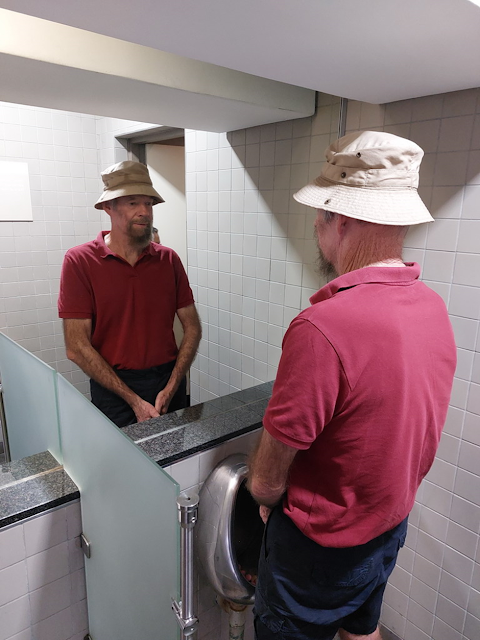
We wandered through the grounds and examined the outbuildings where the dramatic events had taken place, and then looked for a public toilet before returning to the car. A rough brick building that once served as a store had been converted into a modern, well-appointed ladies and gents. I entered the cool interior and stood at the stainless-steel urinal. I had almost finished emptying my bladder when I glanced up and was startled to find myself face to face with my own reflection. There I was, holding my old organ and pissing into the silver receptacle. How extraordinary! Never before had I encountered such a feature in a public convenience. I was actually watching myself urinate! This was a brand-new experience, and it called to mind the labyrinthian mental game played by Borges in his short fictions. It was entirely feasible for someone to stand in the doorway and not only see me from both rear and front, but also to watch me watching myself, and at the same time me noticing the observer behind me. For a brief moment I imagined the arrival of a tall black man dressed like a gardener. He caught my eye in the mirror, glanced down, and said something in isiXhosa, which I took to be both humorous and mildly insulting. Then he was gone.

"Where to now, Guy?” I asked from the back seat as we drove away from Liliesleaf Farm.

“Alexandra township.”

“Ah, that should also be interesting. Hope we don’t get hijacked.”


To view my longer work as an author, you can find me on Smashwords here.

Wednesday, May 8, 2024

One Shot


In my early twenties I went on a mission to take a drink in every bar in Cape Town. Not because I was particularly thirsty, but because I wanted to broaden my education. My aim was to observe the behaviour of ‘the common man’ and reach some kind of conclusion about human nature.

I had discovered that not only do bars attract a variety of men who enjoy a drink in the company of other men, but also that there was an underclass of patrons who retreated to the pub as a place of refuge. They were, without exception, weak individuals who struggled to cope with their own inadequacies and inability to overcome the tribulations that came their way. Like some people go to Church in order to gain solace through communal rituals, these individuals went to a bar to dull their pain with alcohol and to share their troubles with anyone who would lend them an ear.

I found the best time to encounter one of these barflies was between eleven and twelve in the morning. This was before the lunchtime customers started coming in, and anyone sitting at the bar was bound to be an unemployed loser eager to tell me his life story. I soon discerned certain recurring themes that led me to some generalisations about these men and what they had to say. Almost without fail, I would hear a tale of woe in which the narrator was a heroic victim who had been treated unjustly by malicious individuals and by life in general. They all swore they would overcome their adversaries in the future, given half a chance. The testimonies were sordid and the characters despicable, and I listened with a mixture of disdain and compassion. I was able to empathise out of an awareness of my own flawed character. Homo sum, humani nihil a me alienum puto. I agreed with this sentiment that, as a man, I am capable of anything humans get up to, no matter how degrading the choices and actions might be.

Of the dozens of characters I interviewed, one man stands out in my memory, mainly because he blamed himself for the miserable condition he found himself in, and did not tell me a pack of lies about how hard done by he was. It was in the Kimberley Hotel bar, if I remember correctly, and our conversation began when he looked up from his glass of beer and said, “One shot. Only one shot.” All I had to do was say, “Oh, yes?” and he launched into his confession.

He appeared to be around 50, but he told me he was 42. His voice was phlegmy and his lower lip, which was flabby and the colour of cooked liver, trembled as he spoke. His eyes were bloodshot, and I suspected this was on account of a heavy dagga habit. Then I realised the redness was caused not by smoke but by excessive weeping. He blew his nose on a sodden wad of toilet paper and proceeded to tell me how he had messed up his own and other people’s lives. He had cheated on his wife, a wonderful woman, and abused her verbally, physically and sexually. In a drunken rage, he had thrashed his son so viciously the child had ended up in hospital. Through bad judgement, incompetence, dishonesty and laziness he had ruined the family business. This had led to sequestration and the loss of house, cars and movable assets. His wife divorced him, he was refused access to his own kids, and the wider family ostracised him. He was alone in the world. And now, to crown it all, he had been sacked from his job at the City Council after it was discovered he had lied about his qualifications.

“And sometimes I say things to people that I don’t mean to say, and they think I’m insulting them. Just two weeks ago there was this man sitting right where you are, and he smacked me in the mouth.” He curled his upper lip and opened his mouth to display a black hole where an incisor and its adjoining canine had been. I can’t blame him, because I was very rude and I don’t know why. You see, everything I do is a fuck-up. My whole life is a fuck-up and I am all washed up, totally and completely.” He wiped his eyes with the back of his hand and his nose on a sleeve. “You see, you only get one shot at life, and if you fuck it up, that’s it. You can’t go back and live your life again. You get only one shot, and that’s it. Just one shot.”

I left him crying into his beer and went on my way, thinking about this ‘one shot’ business. Was there something in it? Well, before I reached my humble abode in Woodstock, I had decided the fellow was talking shit. How many people fail at something and try again and again, and then strike it lucky and make a pile of money? Or destroy their reputation, only to bounce back and reinvent themselves? And what about all the failed relationships? Christ, you don’t have to curl up and die just because your partner has walked out on you, or kicked you out! No, that man in the Kimberley bar was definitely talking a load of crap.

Like I said, I was in my twenties then, and at the time it seemed obvious the man had got it wrong. Now I am in my seventies and this notion that you only get one shot at life can be interpreted differently. At 40 there is still time to turn things around. But, at 70, if you think your life has been a disappointment, there isn’t much you can do about it. Your mind and body are in decline and the distractions that accompany old age, like mental and physical ill-health, sap the energy needed to tackle some new enterprise that will be so successful you will finally achieve the recognition you believe you deserve. Too late for that, I’m afraid.

So, what options are you left with? As I see it, there are two possibilities to choose from. The first is to rewrite history. This would involve intentional self-delusion starting at no later than retirement age because it takes a good deal of practice to accomplish. It entails constructing a narrative in which you are the leader, and everything that happened in your life was as you planned it. You tell yourself and those around you a version of events in which you are always in control. For example, instead of saying, ‘We went on a family holiday to the Drakensberg,” you say, “I took the family away on holiday to the Drakensberg.” To explain why you never owned a new car, you claim it makes better sense to buy a second-hand vehicle. You don’t talk about retrenchment, but rather refer to the time you decided to change careers. You have always treated your employees fairly, which implies you once had a sizable workforce, when in reality there was only ever a maid, and sometimes a gardener. Of course it was a wise decision to downsize, etc. etc.

By putting a spin on everything that happened to you over the years you can fool yourself and some of those around you that you have led a meaningful life full of purpose and accomplishment. This strategy works for some, but, for individuals like me, it is a feeble subterfuge.

Instead of pretending otherwise, I would prefer to admit that I have led a life of mediocrity punctuated by a series of minor triumphs and disasters hardly worth mentioning other than to amuse myself. This strikes me as a more realistic and honest way to assimilate the memories of one’s past. It is also advisable, when thinking about successes and failures, to bear in mind that heroes and villains, millionaires and paupers all end up dead, and are oblivious of whether they are celebrated and famous, honoured and admired, or despised and maligned, or just ignored as nonentities, whose passing was as insignificant as the squashing of a flea.

In the sense that you only live once, the man in the Kimberley Hotel bar was right. What he failed to see, however, was that having fucked up was nothing exceptional, and instead of feeling sorry for himself, he should have said, “Look, I have screwed up, big time, but it’s no good crying over spilt milk, and I must stagger on and try to enjoy this stupid life, and just treat it as a sick joke, because if you cry, you cry alone; but if you laugh, the world laughs with you.” He should have consoled himself with this kind of hackneyed wisdom, as I do, and carried on with his meaningless existence. Which he probably did. Unless he took one last shot.


To view my longer work as an author, you can find me on Smashwords here.

Saturday, May 4, 2024

How To Deal with a Stray Cat


He climbed the stairs to his room. Olympia Residentia, Kalk Bay. Five years now he had been climbing these filthy stairs to the dark and airless corridor. The foyer and stairs were never swept. Cigarette butts and spent matches mingled with dust and grit, and the southeaster blew scraps of paper in from the street. They whirled in an eddy and were sucked out again. The stairwell smelt of rancid cooking oil from the fish and chips shop and there was the sharp sour stink of cats' piss.

He let himself into his room and shoved the door closed behind him. He immediately saw the cat curled up on the bed. Fuck it, he had left the balcony door on its hook. They stared at one another for a moment and then both moved. He sprang to the door, knocked aside its hook, and slammed it shut. Thin and mangy and grey, it crouched in a corner, a miserable specimen, a useless failure of a creature. A cold, unstoppable hatred welled up in him. He sought about for a weapon. There was only the straight-backed wooden chair. He picked it up, raised it, advanced on the cat. It cowered for an instant and then leapt sideways across the room. As it tried to climb the wall, he swung the chair against it and it fell to the floor, screeching and hissing. One of the chair legs had broken off. He picked it up and smashed it down on the feline skull. He hit the animal several times until it stopped twitching.

He felt warmer after the exercise and lay down on the bed as the light began to fade.

When it was dusk outside and dark in the room, he roused himself, feeling stiff and cold. He turned on the light, it was after seven. Glancing at the cat in the corner he wondered what to do with it. Out on the balcony the wind was blowing without pity. In the street below Basil's lorry revved, its indicator lights flashing, waiting to feed into the evening traffic. Swinging it by its tail, he sent the dead cat sailing out in an arc to land amongst the empty crates as the vehicle pulled away.


(Taken from The Life of Henry Fuckit)

To view my longer work as an author, you can find me on Smashwords here.

Sunday, April 21, 2024

There Is Fuck-All Wrong With My Heart


Two weeks after the Cardiac Ablation, which was supposed to correct my Atrial Flutter, I experienced a mild attack, and then, about ten days later, a more serious episode that lasted for over two hours. I tried to phone Dr L, who had performed the procedure, and was told by his receptionist that she would inform him of my concerns. Two weeks later she phoned me back and, on hearing that I was still alive, said that Dr L suggested I consult my cardiologist in Hermanus and get her to send him an ECG. Accordingly, I phoned Dr M’s rooms and was told she was fully booked for the next five weeks. What could I do other than wait, and try not to have a heart attack in the meantime?

Anyway, to cut a short story even shorter, I saw the woman on Tuesday 9 April 2024 and she conducted a number of tests that included the following, as itemized on her account:

Consultation: R1237.40. This involved greeting me and asking how I was feeling. I told her I wasn’t a hundred percent, because I was worried that I might have another attack if I over exerted myself. She raised her eyebrows and looked at me sceptically. The receptionist was called and I was led into the room containing all the expensive equipment. As can be seen in the photo, I removed my shirt and shoes and sat on the table waiting to be examined.

Cardiac Examination: R4288.50. She felt my pulse, took blood pressure, listened with stethoscope, and shaved some of the hair on my chest before sticking a number of electrodes in place. Lying on my side with arm under head, I watched her at work in front of her fancy computer. First, a two-dimensional examination and then a doppler examination followed by an MMode examination. She did not register surprise, or alarm, or delight, or any other emotion that would give me a clue as to what was going on with my dicky ticker. When she was finished with this, the most expensive part of the examination, she strapped a harness on me, and told me to get onto the treadmill.

This was a brand-new adventure.

“I can see you’ve never been on a treadmill before,” she said with contempt.

I struggled to get the hang of it, but then found my rhythm and began marching at a brisk pace. After a while I thought to myself, shit, this is a poor substitute for taking a genuine walk. No fresh air, no changing scenery and no possibility of a chance encounter. Boring, man, boring. About five minutes went by before she slowed the machine and brought it to a halt.

After removing the harness and ripping off the electrode stickers, along with a quantity of hair, she told me to get dressed and come through to her office. There she explained that she had found no abnormalities, my valves were in perfect working order, and there was nothing to stop me leading a normal life. In fact, I should increase my level of fitness by taking more strenuous physical exercise. A bio kineticist would be useful in this regard. I didn’t bother to ask her what a bio kineticist did for a living. Furthermore, I should stop taking the blood thinners, which were prescribed for patients who were at high risk of an imminent cardiac arrest. In conclusion, she said she did not need to see me again.

As we were leaving, the receptionist presented my wife with the bill. Her eyes widened and then narrowed to slits and I could see she was grinding her teeth. When we got to the car she broke the bad news. R6231.60! And we had been in there for just over half an hour.

“Well,” I said, as we headed for Pearly Beach, “at least the scan was covered by Medical Aid.”

I was referring to the R12000 CT scan I had undergone four days previously. It was the six-month follow-up to see if Big C was still under control, and was covered under Oncology by our Hospital Plan.

“I suppose we should look on the bright side,” she agreed. “you have now been given a clean bill of health and there shouldn’t be any more medical crises for a while.”

“Yes, but one never knows what is waiting round the corner. There might be nothing wrong with my heart now, and the cancer seems to be under control, but that scan left out my brain as well as my genitals and legs. It also showed multi-level advanced spondylosis of the lumbar spine, which would account for my stooped posture, and might eventually lead to you having to push me around in a wheelchair.”

“Forget it. You can push yourself around in a wheelchair. And you can stop drinking if you are worried about your health. I’ll stop buying that cask wine every week.”

At this point I thought it wise to steer the conversation in a different direction .

We had just passed over the Klein River at Stanford, so I said, “This new bridge really is a disappointment. We don’t have a view of the river any more.”

“Purely functional and without any imagination. The design shows a lack of respect for nature and turns a bridge into just another length of road. Remember how you used to tell the children about the weak brown god?”

Years ago, I had shared my enthusiasm for TS Eliot’s Four Quartets and told the kids that the river is a strong brown god, ‘sullen, untamed and intractable,

Patient to some degree, at first recognised as a frontier; then only a problem confronting the builder of bridges. The problem once solved, the brown god is almost forgotten by the dwellers in cities - ever, however, implacable.

Keeping his seasons and rages, destroyer, reminder of what men choose to forget. Unhonoured, unpropitiated by worshippers of the machine, but waiting, watching and waiting.’

Whenever we crossed the old bridge, I would say, “It might look like a weak brown god now, but wait until you see it in flood.” And when we did see it on a few occasions after exceptionally heavy rain, they were suitably impressed, as were their parents, the feeble stream having been transformed into a huge, bloated brown body of muddy water moving like a giant serpent on its way to the lagoon.

“People are stupid not to respect the presence and the power of nature”

“They do so at their peril,” I said. “It’s like refusing to accept the natural process of mortality. They resort to belief in everlasting life rather than overcome the dread of death. I mean, what is so scary about being dead, for Christ’s sake?”

“It doesn’t scare me,” she said, as we narrowly missed crashing headlong into a 20-ton truck loaded with gravel. “In fact, the sooner we all die, the better. What we need is a giant meteorite to wipe us out, once and for all.”

“Quite so. But not just yet, if you don’t mind. First, I must enjoy life for a bit, having been assured there is fuck-all wrong with my heart.”


To view my longer work as an author, you can find me on Smashwords here.

Monday, April 8, 2024

I Would Not Write Home About It


An extract from a young woman’s diary after a one-night stand:

Not very exciting. He had a fair-sized member, but nothing to write home about. That’s funny. Nothing to write home about. Imagine me writing to Mummy and Daddy to tell them that I had just been to bed with a man who was hung like a donkey! We use so many expressions without considering their literal meaning. Anyway, he was nice enough but nothing exceptional. Certainly not the knight in shining armour.


To view my longer work as an author, you can find me on Smashwords here.

Wednesday, March 27, 2024

How to Move a Deceased Relative's Possessions from A to B


The relative who died was AZ, my wife K’s youngest of two sisters. She died unexpectedly in London, leaving K and IZto sort out her affairs. It was known that AZ had property in storage in Cape Town, and on enquiry it was found that the rental payment for the storage unit was six months in arrears. Xtra Space politely informed us that, condolences aside, they would not release the contents of Unit O4 until they were in receipt of R16000. After some telephonic back-and-forth, the 16 was dropped to 12 and finally to rock-bottom 10 take it or leave it.

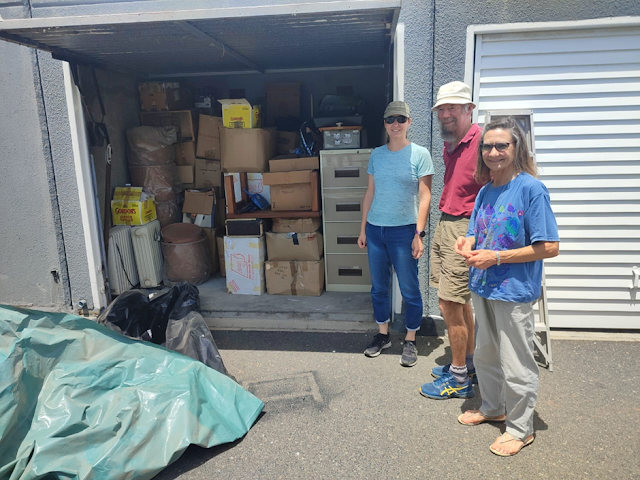
First, we had to make an exploratory trip to ascertain what had been stored for several years at considerable expense. We picked up N and continued on over the mountain to Stink Kaap. Xtra Space was located in an industrial area near the airport and we found it without much difficulty. The woman in charge used a pair of bolt cutters to cut the overlock and allow us to open the tip-up door. The store was half the size of a single garage and it was jampacked with what looked to me like an assortment of worthless household junk. On opening the top drawer of a rusty filing cabinet, however, we found it was crammed with folders containing a multitude of black and white prints as well as sheafs of negatives. This was the treasure trove I had been hoping to unearth.


The next day, Thursday, K made the payment and bright and early Friday morning she was reversing the Venture into N and A’s driveway in Kleinbaai. The small trailer was hitched up to our vehicle and they led the way in their ageing Land Rover to the trailer hire place in Gansbaai. An alarm bell went off in my head when we arrived and were informed that the sturdy double-axle trailer N had booked was unavailable, its spare wheel having been stolen in the night. Instead, we would have to make do with a single-axle version that looked like it had originally been drawn by oxen.

Over Sir Lowry’s Pass we went and on the other side called in at the first filling station for a piss stop. While parked round the side, a car pulled up behind us and a man got out in a hurry, looking like he was both happy and excited. N seemed to recognise him and they had a brief conversation before he waved goodbye and departed.

“Pike,” she said, and handed me the man’s card.


This is what makes life worth living. The miraculous appearance of one of Pike’s representatives, like a guardian angel come to check up on us, was both comical and reassuring. It was a reminder that we are not alone in this world, and that we should never give up hope because, even in the direst of situations, fate is capable of taking an unpredictable twist. Not that I believe in fate, or guardian angels, or any of that shit, but I was genuinely delighted and amused that Pike had once again swooped down upon us.

“What did you tell him?”

“The usual. You’re not interested in selling, but if you change your mind, you will contact him.”

We arrived at Xtra Space at 11.30 and, after a delay while they checked to see if the EFT had gone through, we set to work loading up the Venture and the trailers. It was hard labour, and would have taken twice as long without A. He is built like a sumo wrestler and is capable of feats of prodigious strength.


Long before the store stood empty, I had begun to feel waves of trepidation and in need of something to calm my nerves. By the time the last items were piled onto the big trailer, its springs were almost flat and the chassis cleared the wheels by no more than an inch. I couldn’t see how we were going to make it out of the gate and into the road, let alone go all the way to Gansbaai. To my amazement and growing sense of relief, however, we reached the N2 without incident and pressed on, the Land Rover leading the way.

It was after 2 on a hot Friday afternoon, and the traffic was already backing up as we approached Somerset West.

“This stop-start crap isn’t good for his clutch,” I said.

We made it through three sets of lights when, uh-oh, he began to drive in the emergency lane. We also pulled to the side and cars overtook us. The flow of traffic was beginning to speed up, which was encouraging, because it meant we would be able to get a run at the pass, if only the Rover’s clutch held out. Halfway up the first long incline we ground to a halt. Five minutes elapsed and then we heard him revving the engine, and again we were on our way. Round the hairpin bend we crawled before having to take another breather. We had started on the steepest stretch and cars were passing us at a steady rate. K was looking anxious, and she later said it was then that she contemplated offering up a prayer. Once a Catholic, always a bloody Catholic. Three hundred metres from the top of the pass we slowed to a walking pace and I was suddenly struck by the memory of a scene from John Steinbeck’s The Grapes of Wrath. We were like the sharecropper migrants, piled up with our worldly goods struggling to reach the promised land in an overloaded jalopy.

This, I thought, is what it must feel like when making the final ascent on Mount Everest with the weather closing in. Would we make it, or would the expedition end in disaster?

The intrepid driver and his navigator coaxed the flagging old Rover up the last few metres and, to our immense joy and relief we followed them over the summit and began descending into the land of milk and honey.

“Now he can coast for a bit and rest that clutch and clapped-out engine.”

“But not for long,” my wife said. “There’s that hill to climb after the dam.”

“Ah, that’s nothing.”

Like fuck, it was nothing! Halfway up he was driving on the verge, slower and slower until all progress ceased. K turned off the engine and we sat listening to the traffic rushing by, and watched the long grass at the side of the road waving in the wind. After about five minutes N got out and came and stood at my open window.

“Looks like that’s it,” she said. “We’ll have to get a tow.”

It now emerged that it wasn’t just a diseased clutch that the aged vehicle suffered from. Why the engine kept losing power was because it was being starved of fuel.

“Dirt in the tank,’ N explained. “It’s the petrol we got from those fuckers in Kleinbaai. We will have to call for a tow truck.”

She went back to A and after ten minutes returned. For R4500 a tow truck with flatbed would get the Land Rover and trailer to Gansbaai. K and I looked at each other in dismay. This was proving a very expensive operation, but there was no alternative. When the outfit arrived she would make the EFT. N gave them the go-ahead and said they promised to be with us in half an hour.

More than half an hour elapsed and she was on the phone again.  Twenty minutes. N and A were standing beside us, anxiously watching the stream of cars coming up the hill. Still no tow truck, and then a car pulled up behind our little trailer.

“That bloody Pike again!”

She went and spoke to the man, and when he headed off he gave a cheerful toot-toot and a thumbs-up.

“He’s on his way back to Swellendam, and he’s oh-so-happy it’s not the Venture that’s giving trouble.”

A was looking grim, as if he needed to get into a brawl. He muttered something to N and stomped back to his troublesome work horse.

“He says he is not waiting any longer for those lying bastards.” We heard the engine start up. “I had better move it, or he’ll go off without me.”

From there on the Land Rover chugged along at a steady 80 all the way to Kleinbaai without stopping once. It was later agreed that the protracted wait had allowed the sediment in the tank to settle and thus the fuel supply had kept flowing uninterrupted.

As for the tow truck, K and I admitted to feeling a twinge of guilt at not having waited for them, but agreed it was not worth losing any sleep over, as these scavengers were notorious crooks and liars and did not deserve any sympathy. And R4500 was a rip-off we could do without, anyway.

We stopped at the OK in Gansbaai to buy a few groceries and it was well after six by the time we reached Kleinbaai. N and A were already unloading the contents of the trailer into their double garage. We slaved away for more than an hour emptying the trailers and the back of the Venture, and I again marvelled at A’s strength, shuddering at the thought of having had to accomplish this mission without his and N’s help.

Finally, we were done, and all that remained was for the big trailer to be returned to its owners, and for K and I to get back to Pearly Beach. It had been an exhausting and stressful day but, with a great deal of luck and help from our guardian angel we had managed to move our deceased relative’s possessions from A to B without mishap. hallelujah!


To view my longer work as an author, you can find me on Smashwords here.


Monday, February 19, 2024

The Treaty Tree


On the pavement there was a man lying on his side with his legs drawn up. Snoring loudly, he lay with his cheek pressed to the paving slab, his open mouth a slack hole. One arm was tucked under him, elbow jutting behind, in front his hand palm up. The other arm was bent prayer-like, the hand laid palm down on the pavement before his face. He was lost in the grateful oblivion of the dead drunk. Henry stepped round him and crossed Albert Road.

Treaty Road was a narrow side street marked by a church school on the corner. Grimy and dilapidated, the school blended in with the surroundings. Pausing, he looked up at the wall and contemplated the cross surmounted by the name of the school. He sought for an apposite phrase. Did the cross merely symbolise 'Church', or did the locals regard it as signifying something more complex and abstract like, 'the love of Christ', or, 'the pain and suffering of mankind?' What of Promise, Justice and Goodness? Did any of them regard it with bitterness as a symbol of 'superstition and ignorance'?

A gust of paper and grit blew across the street and he hurried on. Although the clouds were few the blustery southwest wind robbed the afternoon sun of its warmth.

He saw no sign of the tree. The road seemed to end at a set of rusty gates in a wall of crumbling brick that surrounded a half demolished warehouse. Beyond lay the railway tracks, a factory and the docks. When he approached the gates he saw that the road turned to the right and followed the wall. There at the end was a tree.

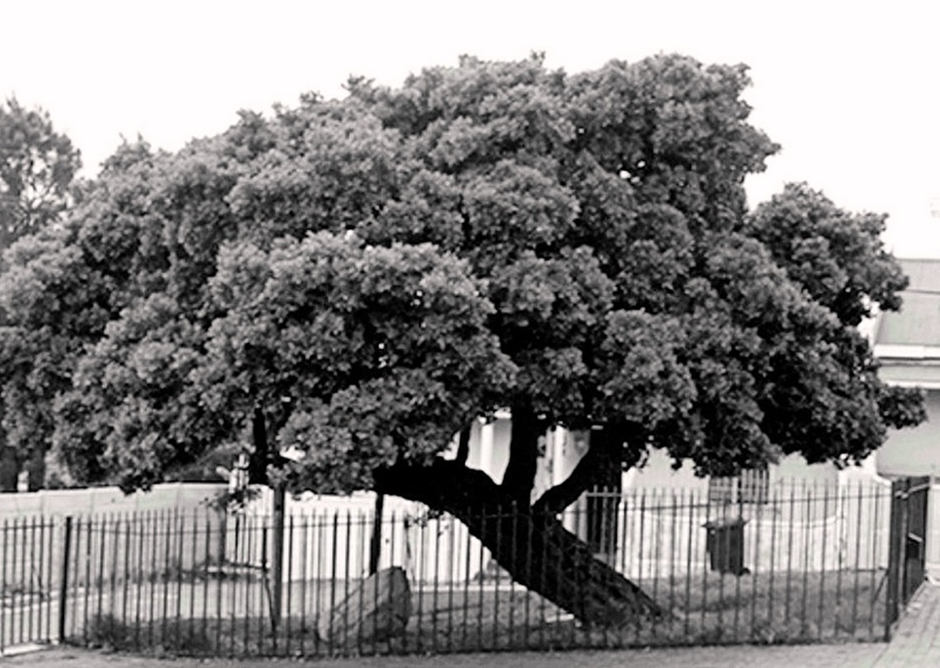
He had seen the white milkwood at Mossel Bay, the Post Office Tree. Huge, gnarled and ancient, maybe six hundred years old. The Treaty Tree was not as impressive, though its thick, twisted trunk was evidence enough that it had been standing there for some three of four hundred years. He admired the dense foliage, the rich dark green of the shiny, rounded leaves. The tree was protected on one side by a wall in which was set a brass plaque proclaiming the monument. Next to the tree had stood a house where the commander of local Dutch defences had formally handed over the Cape to the British after the Battle of Blaauwberg in 1806.

He tried to imagine how unspoilt the area must have been in 1806. Low dunes with grass and yellow flowering sea pumpkin, and sails in the bay. Now look at it. The plot of grass where the house had stood was kept neatly mowed by the Council and there was a park bench. But the view beyond was grim. The ugly utilitarian shape of a warehouse made more unsightly seen from the rear, a derelict site littered with rubble and refuse, the long, crumbling brick wall.

He turned from the tree and was confronted by a coloured woman. He had not noticed her approach.

"Master, gee vir my 'n sigaret. Asseblief, Master."

"I don't smoke" Henry replied.

She looked about thirty and wore tight black pants and a dirty blue cotton coat. Her hair was concealed by a woollen cap. She had a shapely figure but her face looked raddled and puffy. She carried a plastic bag and he heard the clink of empty bottles.

"You don't smoke, Master? I'm a smoker. I'm also a drinker." She giggled. She was probably drunk: there was an aggressive air about her. He began to move off. "Give me ten cents, Master. Vir 'n dop"

He shook his head. He tried to imagine the kind of life she led.

"Do you know about this tree?" She looked blank. "Did you know that this is the Treaty tree?" She eyed him suspiciously.

How remote she is from me, he thought. Of course she knows nothing of the tree. It was a tree. What did she care?

"You want to come with me?" She asked, gesturing towards the wall. He was a little surprised and began to walk away. Bound to be diseased, anyway. Then out of curiosity he turned.

"How much?"

"Five rand." He laughed. She came and stood close to him. "Net twee rand." She was dark skinned and her face was marked. He could smell the wine on her breath and see the offensive boldness in her eyes. "Net twee rand. Kom jy?" She was slightly impatient.

Henry made a motion with his hand and she understood. He followed her to a point where there was a break in the wall. There was nobody in sight. She led the way to the partly demolished building and they passed through a doorway into a room that had four walls but only the sky above for a roof.

How easy to do the wrong thing again. No clamour of warning in his head. Merely a vague idea that this was not the right thing. No intuitive surge of feeling to counteract the rising curiosity, excitement, and sexual urge. Just a faint, toneless voice disinterestedly making a statement: wrong. How unpersuasive.

His heart was thumping fast and he felt shaky in the legs. She turned round and put down the bag, the bottles rattling together on the cement floor.

"Kom" she said, smiling to reveal two missing teeth. Henry unzipped and lowered his trousers and she began.

Henry was particularly excited by the darkness of her hand, the contrast of brown against white. She was expert and unhurried and he stood leaning against the wall, arching his body back in sacrificial abandonment. Then he clutched her hand holding it down, hard.

Henry gave her the money and hurried away, wondering why he felt so unashamed of himself.


Why did I do it? It was such an easy defeat. I don't' think I put up any resistance at all. Possibly I didn't even realise I was being attacked. But then, what was wrong with it anyway? A minor incident in the daily economic life of the city. A straightforward transaction between two persons, one providing a service, the other, the consumer, paying the agreed price upon satisfactory delivery of said service. No coercion, no exploitation. No exploitation? Well, of course there was exploitation. I exploited the vulnerability of a 'fallen woman' and paid her to perform yet another demeaning act, thereby further undermining what was left of her self-respect and regard for her fellow beings. But what if she had come to Palmerston Road and knocked on my door and offered to clean the windows for two rand? If I had then given her the choice, clean the windows or milk the bull for two rand, I'm sure she would have gone for the bull without hesitation. Ho-hum, who am I trying to deceive with this specious bluster, this beating about the bush? There's no necessity for an ethical debate - in my own eyes, according to my own values, according to my own notion of how human beings should treat each other, my action was plainly immoral. Instead, what I should be trying to determine is why I repeatedly succumb to the wrong impulse. Maybe the initial impulse can be ascribed to my active imagination and openness to novel or exciting situations. A dilettante's unencumbered disposition at play. But the conception of possibilities should be accompanied by judgement and choice. The moment the migratory thought of hiring the woman's services crossed my mind an alarm bell should have sounded. A neon sign should have lit up proclaiming a bold warning. Something like ACHTUNG, or WATCH IT, PAL, or PAS OP VIR DIE GEVAAR. Without a moment's hesitation that clear warning should then have been heeded. I should have immediately turned my back on the temptation, discarded the impulse and walked away. For my own physical safety and peace of mind it should become an unquestioning habit, as automatic as a conditioned response in a laboratory rat. I see the danger; I don't even think about it; I just walk away. And to hell with the voices extolling life as an open-ended adventure and deriding the insipid gentility of virtuous action.


Taken from The Life of Henry Fuckit

To view my longer work as an author, you can find me on Smashwords here.


A Conversation with AI

    (Image: Ideogram.ai)   Are you more knowledgeable than any human? Not in the way a human is. I can access and synthesize a muc...